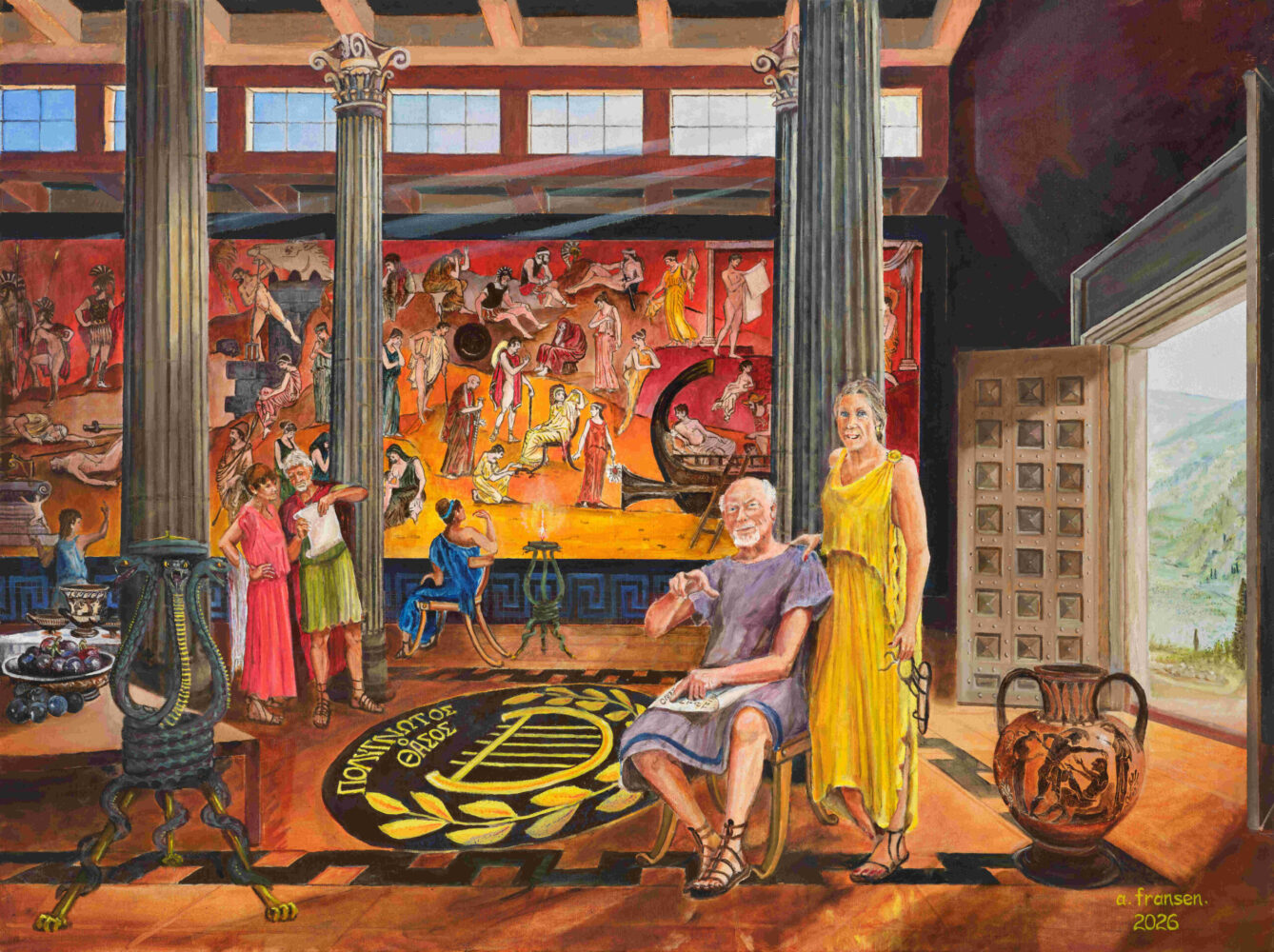
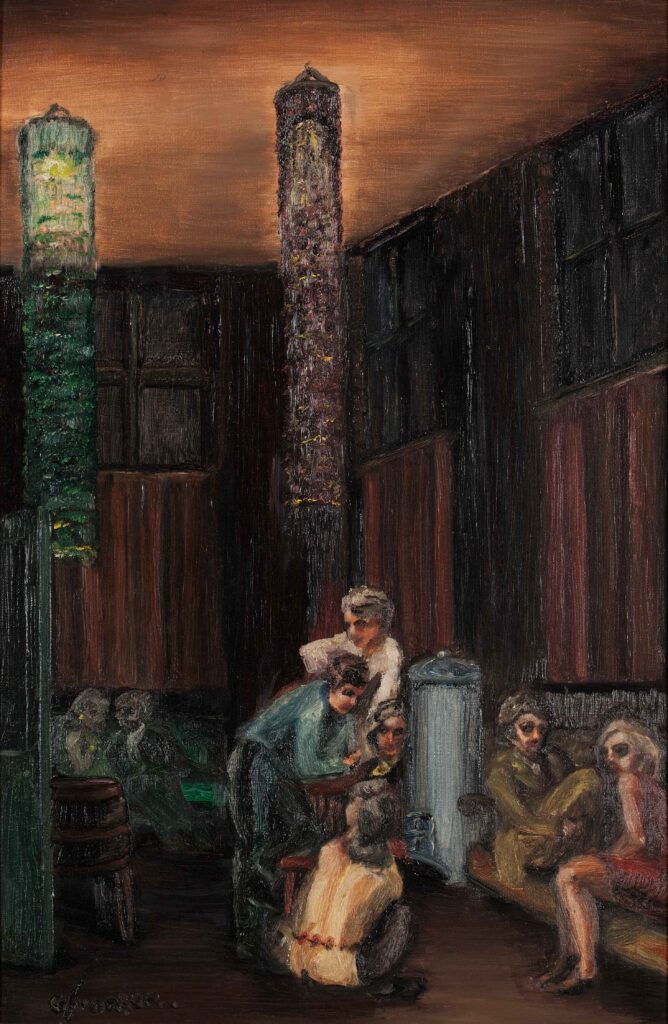
This painting is a tribute to the painter Polygnotos of Thasos. He lived and worked during the first half of the fifth century BC. Nothing has survived except stories about him and, it is believed, echoes of his work in Greek vase painting.
Reminiscences
André Rieu performing Shostakovich’s The Second Waltz, live in Maastricht, The Netherlands
The piece Benedictus, from Karl Jenkins’ choral work The Armed Man (2000)
Read more
Through his work in Athens, Polygnotos became friends with Kimon, and even more so with Elpenice, son and daughter of Miltiades (the hero of Marathon in 490 BC), respectively. His commissions likely stemmed from the prevailing euphoria following the Persian defeats and the development of the world’s first democracy under Pericles. A piquant detail is that this statesman was openly criticised by Elpenice, apparently a woman of stature.
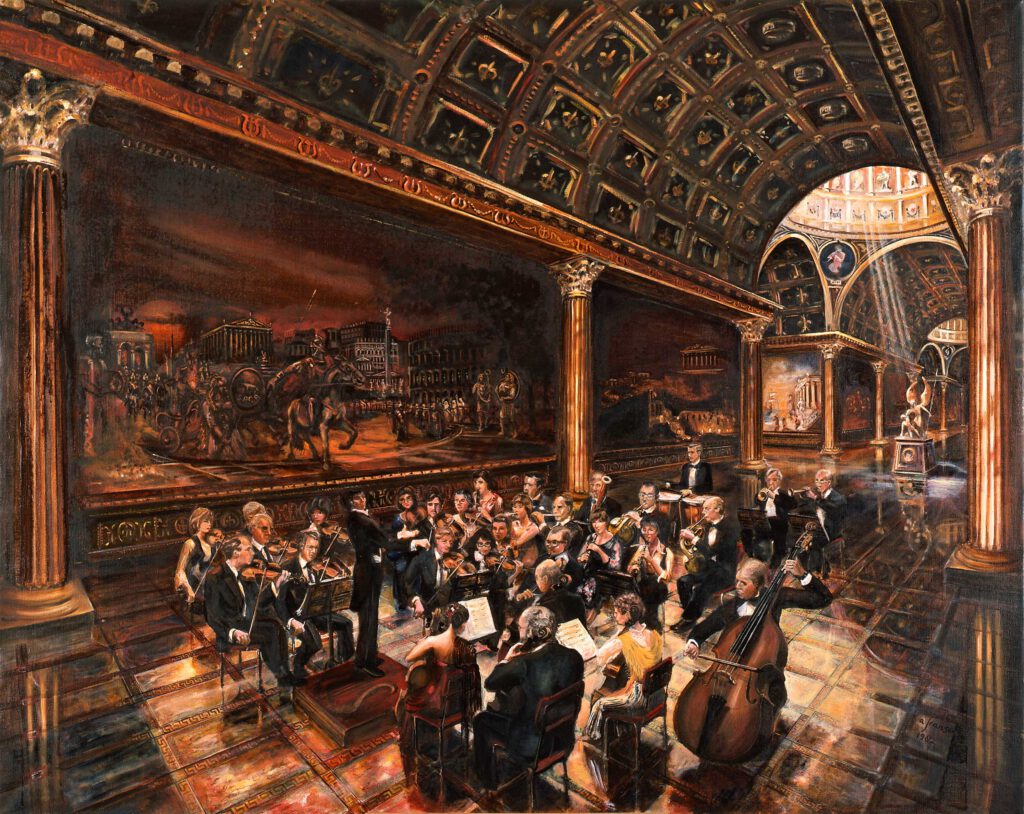
My painting is about his most famous work; two gigantic wall paintings (probably frescoes) in the Lesche of the Knidiens in Delphi, created around 460 BC. Upon entering this ‘clubhouse’, the Ilioupersis was located on the right, and opposite it, on the left wall, the Nekyia. These paintings were described with extreme precision some half a millennium later by Pausanias in his book 10, chapter 25. Those descriptions were used for drawn reconstructions by the painter Hermann Schenck (1829-1912) based on an extensive study by Carl Robert in 1893 of the translation from Greek into French by an abbot named Gedoyn in 1731. We are here in that Lesche, which no longer exists either, with the Ilioupersis, or the Fall of Troy, in the background, almost exactly according to that drawing by Hermann Schenck.
As an imaginary visitor together with Liesbeth and friends, I point to a fragment in the Nekyia. For example, to the moment when Odysseus, having descended into the underworld, actually meets the legendary seer Theresias, hoping that he can tell him the shortest route home, to Ithaca. Behind us, we see part of the right section of the Ilioupersis, primarily depicting the disastrous consequences of war, represented by the desolate posture of abducted women and children during the embarkation. In the center sits Helen, true to her leading role. Her fate remains uncertain. Presumably, she realises that the war was not actually just about her …
This mythical European primeval war at the beginning of the 12th century BC is described in Homer’s world-famous Iliad. It contains all the elements that we see reflected in European literature and art history to this day: ‘For edification and entertainment’.
Unfortunately, as becomes clear time and again, more for entertainment than for edification!!
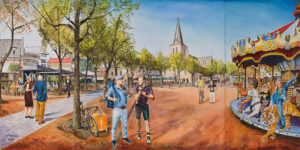
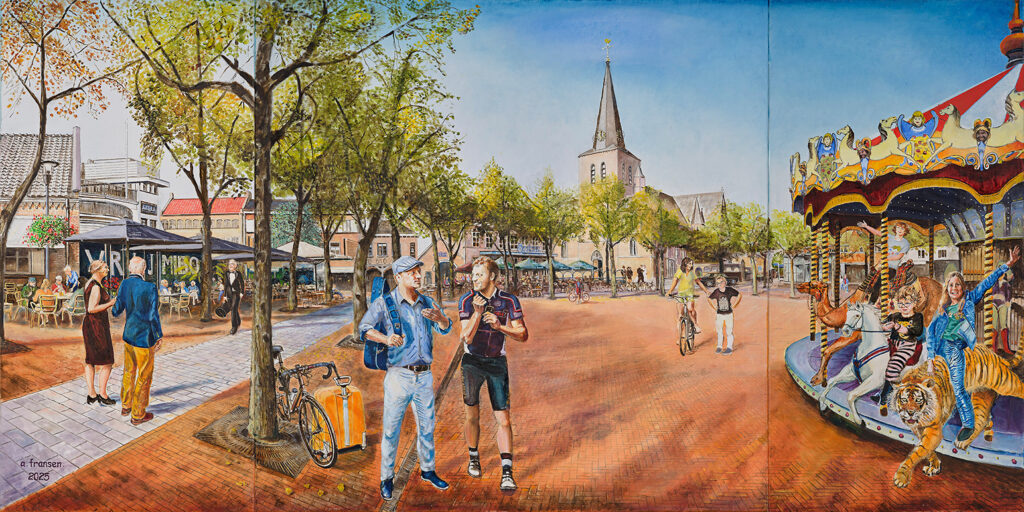
Merry-go-round (or Memento Diem)
Oil on canvas (cotton) · 100 x 200 cm (triptych 50 + 100 + 50 cm) · March 2025
A merry-go-round represents a wonderful contradiction. Seen from the outside in, the mechanical predictability of the merry-go-round spins, enriched by the equally programmed music of a fairground organ. Seen from the inside out, the environment spins around us. That environment, our world, hopefully remains unpredictable, invitingly beautiful and challenging for the child (also within us).
Reminiscence
Le Carnaval Romain by Hector Berlioz opus 9 1844.
Read more
Both nostalgia and euphoria resonate in this music, just as I want to show in the painting.
What is it all about (in life)? I posed this question to my guests at the opening of this painting exhibition in museum De Wieger on 13 March 2025 (see Exhibitions).
Around us, it seems increasingly to revolve around acquiring knowledge in the form of information about each other, fine in itself, but in the hands of a few it also means power, it turns out, even more so than with the acquisition of money.
John preached long ago, however, that it is about love for each other, knowledge but no power, he got that from no stranger.
In this work, it is indeed first and foremost about love; the affection between partners, between brothers, sisters, parents and children, and also between friends. All this against a background of freedom. The freedom to be together in safety in the first place.
The freedom to talk about big and small joys, about joys and sorrows, and to conduct social debate in direct contact with each other. This, after all, is seen as the basis of democracy, but to prevent polarisation, preferably not via social media. Even if personal confrontation chafes, it sharpens the mind; no friction, no shine, every painter knows that.
VRIJMIBO is an acronym for Friday afternoon drinks, a beloved tradition for Liesbeth and me with our friends, at five o’clock sharp.
FREE (VRIJ), pregnantly present as a syllable in the scene, stands for the freedom described above and, in addition to a quality, also means the verb ‘to love’ (vrijen) in a very broad sense in the vernacular here.
GMC
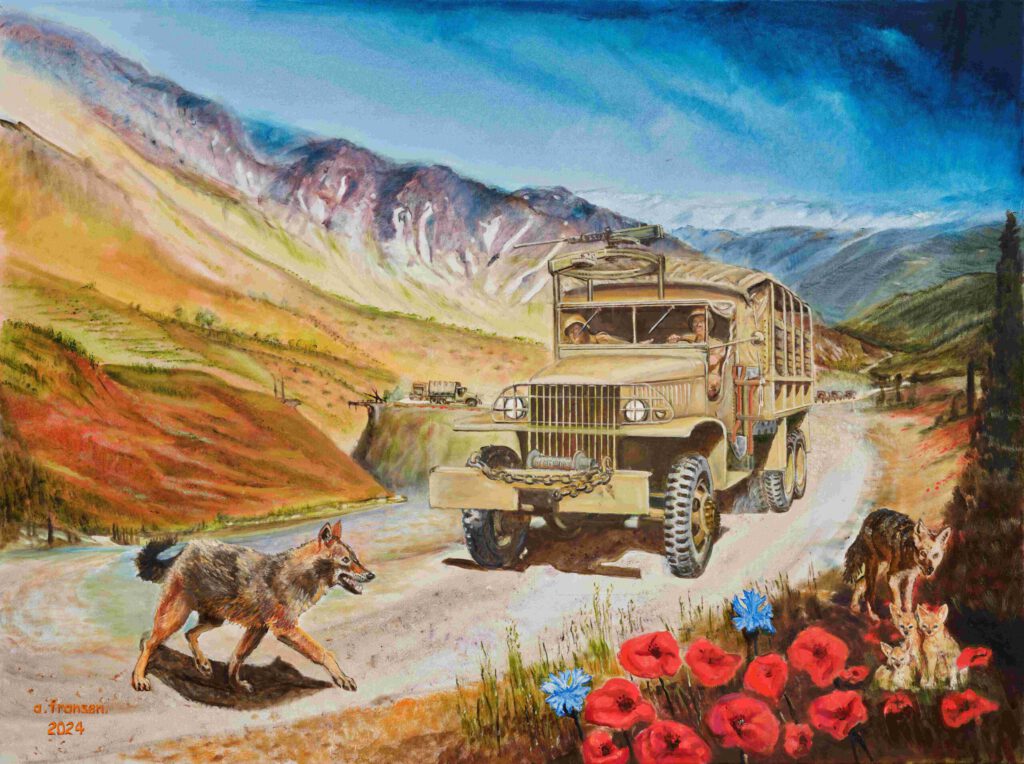
Oil on canvas (cotton) · 90 × 120 cm · July 2024
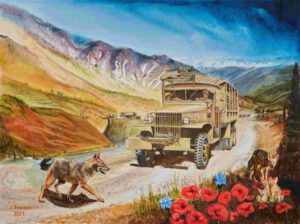
This type of army truck played a prominent role in, among others, the Red Ball Express of 1944. At the moment, I see the effort of the NATO countries to provide Ukraine with military equipment in the war against Russia as a magnified Red Ball Express.
Associations with the jackal through the centuries have to do with loneliness, desolation and death on the one hand, and with cunning on the other.
The jackal also represents our assumptions and judgements that cause differences of opinion to escalate into conflict. Only negative associations in short?
Reminiscence
De Libertate (про свободу). Taras Kompanichenko & Chorea Kozacky.
Read more
The GMC CCKW 353 2.5-ton cargo truck from WW2, nicknamed Jimmy in the USA, was also called Liberator in Europe after the war. Of the more than half a million units built, a quarter, like this one, were equipped with a machine gun ring and a front-mounted winch. The open cab version with canvas roof shown was easier to ship than the original model with the steel cab. Even after my military service with the Supply and Transport Troops, where The Red Ball Express, with its GMCs and heroic drivers, was the shining example or role model, I have remained fascinated by this archetypal truck.
Less well known is that racial, and therefore highly debatable, motives played a part in recruiting the huge number of drivers needed; 75% were African-American. Estimated beforehand, in fact, only 1 in 10 reached the destination, being the advancing divisions of Generals Patton and Bradley.
So much for 1944 and the end of WW2. At the moment, the ruthless opportunism and deception by the current czar and his government is evident. The similarity between the two situations is that morality has given way to unscrupulous cunning. For me, the stereotypical image of the jackal. However, the jackal family shown also visualises my gradually positively adjusted view, based on interpretations we already encounter in older civilisations.
The Egyptians saw the jackal, in the person of Anubis, as the protector of the journey after life into death, something that was apparently considered very difficult. In other cultures, the jackal still symbolises a life motto based on its resourcefulness, adaptability and strong family bond. A motto that encourages navigating through (life-)dangerous situations with cunning, intelligence and cooperation.
Levidi | Λεβίδι
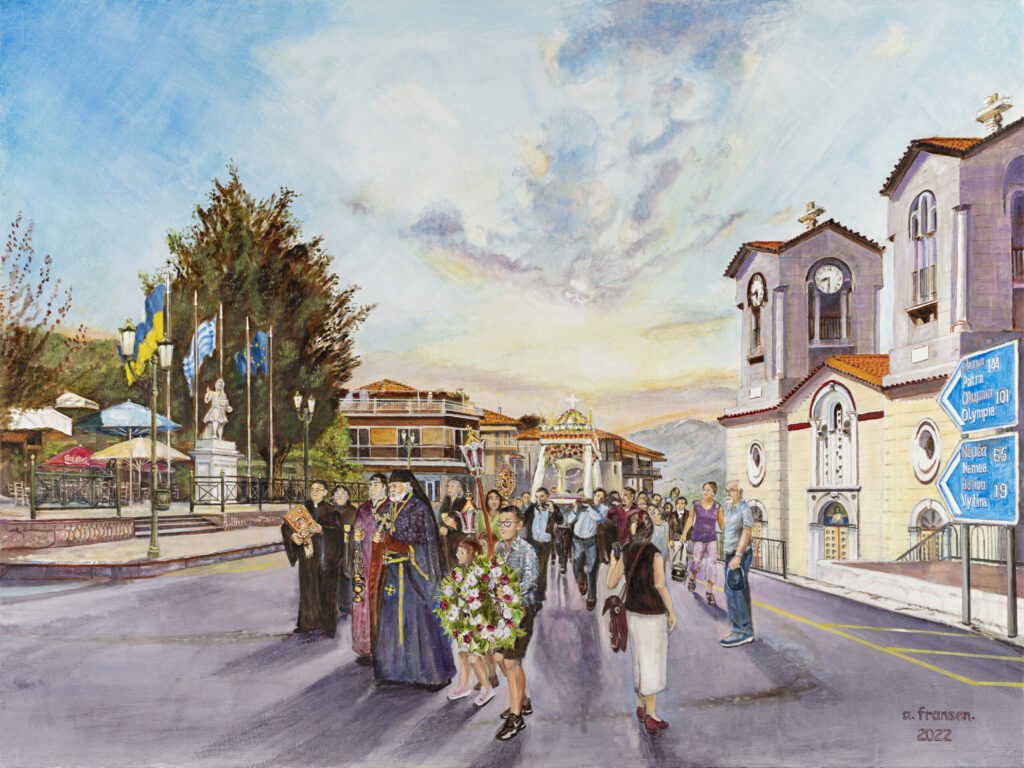
Oil on canvas (cotton) · 90 × 120 cm · December 2022
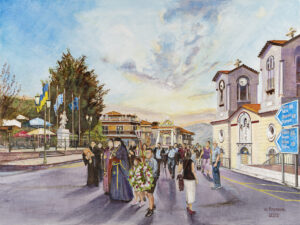
Levidi is a town in the middle of Arcadia (Peloponnese, Greece).
During our trip in the summer of 2022, the city center caught my attention, initially purely because of its picturesque aspects. Only later did I read about an event at the start of the Greek War of Independence around Easter 1821, on April 14 to be exact. A story about partisans, despair and exceptional bravery. Partisans were dismissed by the aggressor as thieves (klefts) in front of the Ottoman rank and file and the Greeks who turned a blind eye. This was of course a reversal of the actual situation.
Reminiscence
Megali Paraskevi (‘Good Friday’). Performed by Vicky Mosholiou. Composer: Stavros Xarhakos. Author: Nikos Gatsos. Recorded: 1972.
Read more
In 1821, these klefts had already had a fairly universal motive for 400 years, namely overthrowing the yoke of oppression of the occupier-oppressor with deviating norms and values, especially with regard to religion.
A remarkable similarity arises here with the current situation in Ukraine since February 24, 2022, where there is also an aggressor who shamelessly uses misinformation; a misleading narrative of sameness has been used to justify the occupation. Indeed, in both Moscow and Kiev, the main religion is Orthodox Christian, a legacy of the Greek (or rather Byzantine) Church. It goes without saying that the love for one’s neighbour is at the heart of each Christian religion, including these orthodox versions.
I want to show the absurdity of this situation by directly referring to the undoubtedly second most important momentum in this religion, namely the Entombment of Christ on Good Friday (Megali Paraskevi). He, the epitome of charity, was condemned and put to death by the Roman ruler, who made good use of the misinformation raised.
The procession we see here is indicated by the Greek word Epitaphios. The hero of April 14, 1821, traditionally depicted as kleft, is Anagnostis Striftombolas (see the statue opposite the church).
Heuvelstraat (‘Hill Street’)
Oil on canvas (linen) · 100 × 140 cm · September 2022
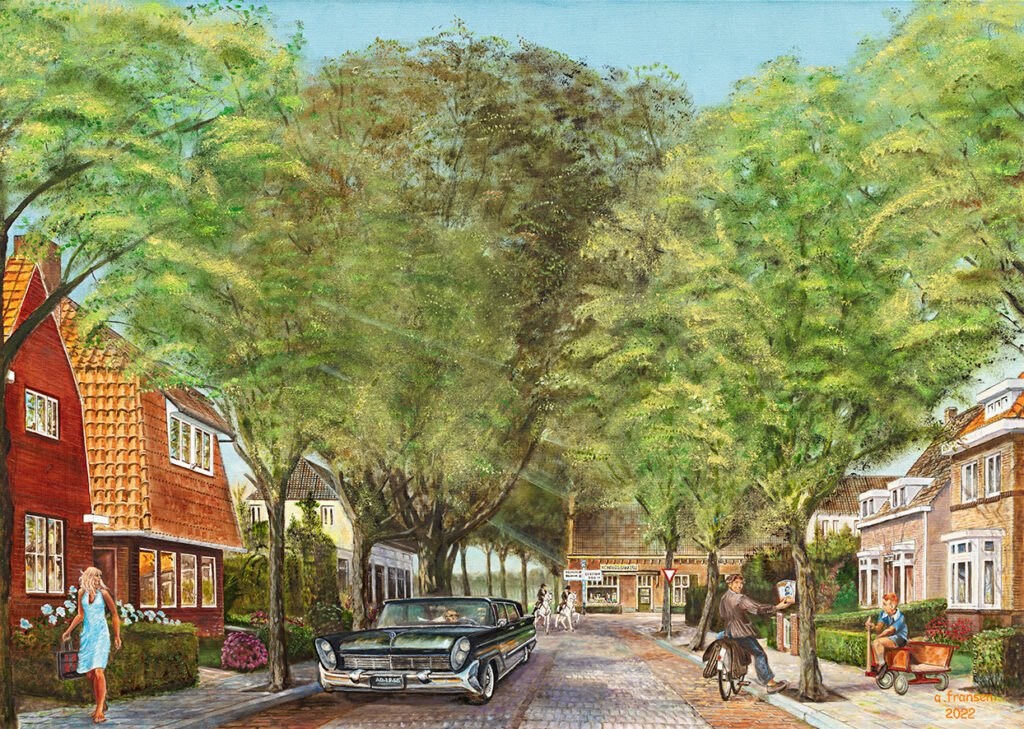
Midsummer in the fifties, June is the month of fragrant flowering lime trees.
However, from 1970 this quiet village street turned into a traffic artery straight through Deurne. Since then, almost all these lime trees, as well as the giant chestnut tree at the back of the street, have disappeared, what a pity. This too is the prize for what we call progress!
With this painting I want to evoke the environment where I grew up with my sisters Cisje and Berthie. Within that environment there are some other strong memories …
Reminiscence
1960 Oscar winning song: τα παιδια του πειραια from the movie Ποτέ την Κυριακή. Known as: Never on Sunday. Composer: Manos Hadzidakis. Singer: Melina Mercouri.
Read more
1961: the beginning of the hippie era. A beautiful girl walks by, barefoot; her name is Magda.
1958: we see Dr. Hub van Doorne (president of DAF) in the back of his Ford Lincoln Premiere with a newspaper, the driver is Harrie van der Heijden. Incidentally, this is also the year that the DAF Variomatic is launched on the market. After its introduction, they commute between Deurne and Eindhoven in this much smaller car, instead of in the depicted presidential sled!
His beloved daughters, the twins Anny and Tiny, are returning from a forest ride on their snow-white Lipizzaners.
1955 or maybe a year earlier: we see a man on his bicycle, loaded with bags full of magazines. Every week I was keenly awaiting the new Disney comic being delivered. Driek (Hendricus) is about 47 years old here, young at heart, joyfully pursuing many activities, including delivering the latest comics to children. Maybe that’s why he lived to be no less than 101 years.
A few years earlier there were the escapades with my handcart on the sidewalk. With the right leg kneeling in the cart and the left scooting, I managed to go superfast. To this day I remember the feeling of that vibrating ’tiller’ in my hand and the sound of the wheels thumping on the flagstones.
This handcart is still used by my grandchildren. My father — their great-grandfather — made the cart for me after the war according to the construction principle of DAF (Van Doorne’s Aanhangwagen Fabriek), originally a trailer factory, later an automobile factory.
Mouseion | Μουσεῖον
Seven parts · oil on canvas (linen) · 170 × 200 cm · December 2021
Part of Manteion trilogy together with Oracle (2019) and Hybris (2020)
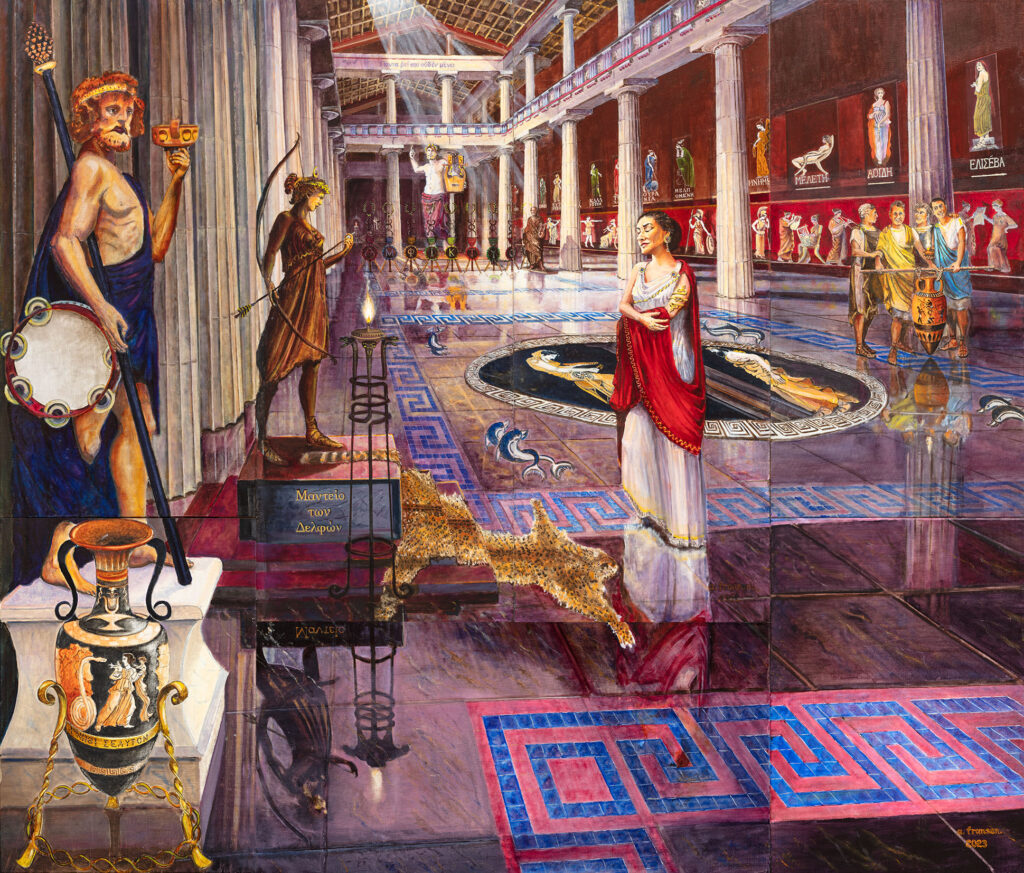
The interior of the long-gone Doric Apollo temple at Delphi is depicted here, with some imagination; the atmosphere and even the building itself are partly invented. The colourful muses painted on the wall represent inspiration in science and the arts; basically the ancient foundation of civilization to this day.
The oracle of Delphi was a woman, who, in her role of priestess, was called Pythia. While the oracle operated for almost 1000 years (600 BC to 392 AD) in a temple like this one, it is in fact thought to be much older. The demanding nature of their role may have led these women to seek refuge in Artemis, the twin sister of Apollo, a powerful and woman-friendly being among the divine company.
Reminiscence
Casta Diva, ‘Kuise Godin’, aria uit de opera Norma van Bellini; door Maria Callas met l’Orchestre de l’Opera National de Paris o.l.v. Georges Sebastian, live opgenomen in het Palais Garnier op 19 december 1958.
Read more
This painting, together with two other paintings, forms a trilogy called Μαντείο των Δελφών (Manteion ton Delphon, ‘Oracle of Delphi’). The other paintings are: Oracle from 2019 and Hybris (ὕβρις) from 2020.
The scene shows a museum-like environment, hence the title Mouseion, ‘temple of the muses’. The nine Muses (Μοῦσαι) were companions of Apollo and personified the nine fine arts, or sciences and arts. The muses were also called Parnassides after their residence on the Parnassus at the Kastalia well at Delphi.
A woman of ordinary descent, the oracle of Delphi (Pythia) was chosen for her mental and physical qualities; her position was demanding, and probably not without health risks. I wonder what all this meant for this lady and her loved ones, especially the fact that she must have been confronted with the big dilemmas of the most powerful people of her time — essentially the same political dilemmas of our own time. I can’t help but think that morality was a complex issue for her after having performed her oracular duties, particularly when war and peace were at stake.
Rhapsody in Blue
Oil on canvas (cotton) · 60 × 80 cm · May 2021
Rhapsody etymologically: from the Greek rapsōidia, meaning an epic poem recited by a rhapsode (troubadour). From raptein “to intertwine, to sew together” + ōidè “singing, poem” (cf. ode).
In addition to the colour, blue can refer to a gloomy, desolate state of mind.
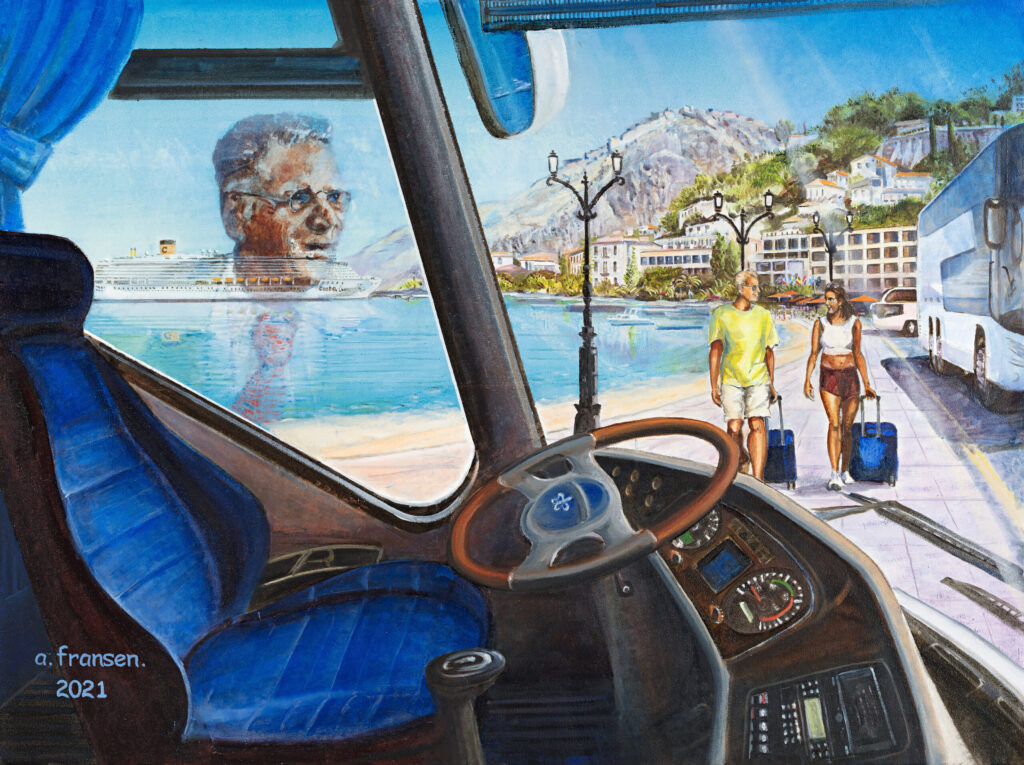
This painting employs variations in blue to show a contrast: a sunny, carefree populated beach boulevard on the one hand, and the unredeemed desire to travel on the other hand, felt from the cockpit of a luxury coach.
Reminiscence
From Rhapsody in Blue by George Gershwin, performed by the Royal Philharmonic Orchestra, conductor Barry Wordsworth, piano Christopher O’Riley.
Read more
When Beitske was working in our house, her husband Klaas was usually behind the wheel of his coach, on the road to, say, Italy (or in this case Nafplion in Greece) —often with secondary school pupils and their teachers. Driving and interacting with his passengers, both of which he was very good at, meant all the world to him.
The painting is intended as a reminiscence of beautiful images from that time, but with a melancholic undertone.
Hybris | ὕβρις
Four parts · oil on canvas (cotton) · 170 × 200 cm · December 2020
Part of Manteion trilogy together with Oracle (2019) and Mouseion (2021)
Design after the model of Nicos Andricakis, published in Delphes by Ekdotike Athenon S.A. 1980.
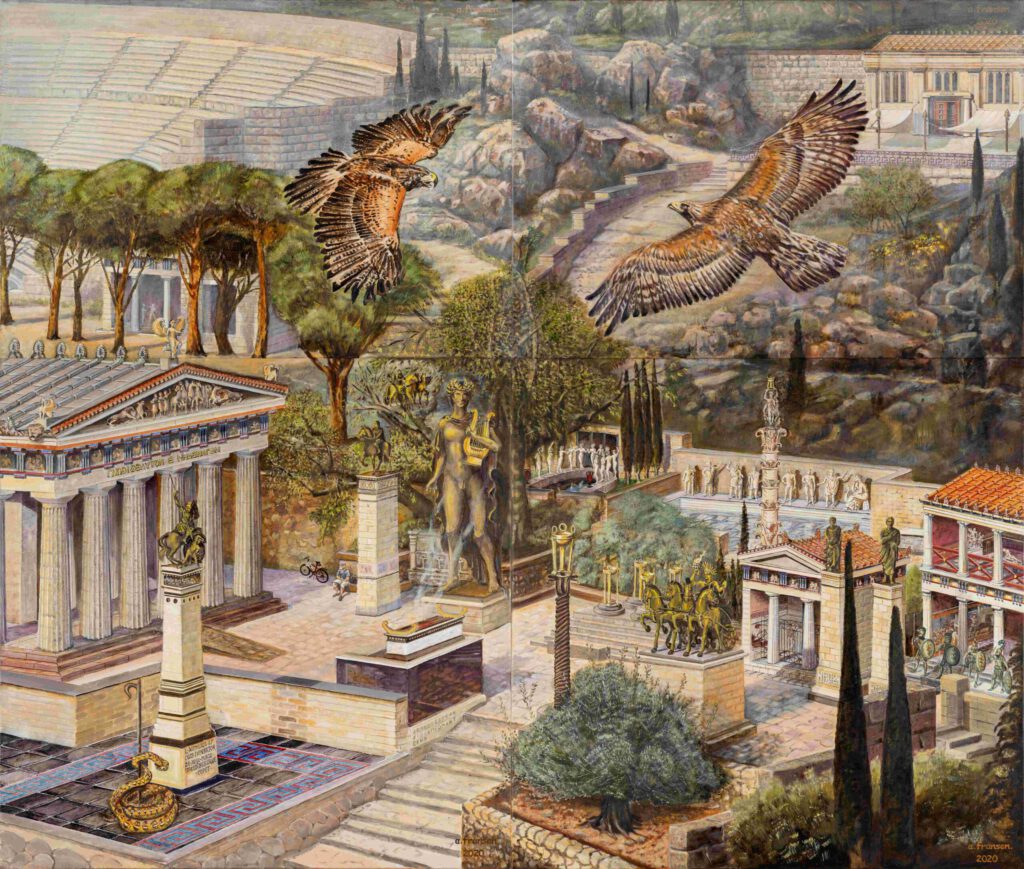
This is an impression of the sanctuary of Apollo, ancient Delphi, from the perspective of the eagle. According to myth, Zeus sent two eagles to find the centre of the world, which turned out to be Delphi. This place existed as a sanctuary for more than a thousand years; now, sixteen centuries later, only ruins remain.
The old world-view with fate-foretelling and other governing gods has been dissolved in history. A new idea arose; man with his gigantic achievements became the ruler of nature and the future, instead of a god. This now appears to be equally incorrect, however beautiful he and she may be in God’s image, or vice versa.
How promising are those essential achievements to survive unhinged and strangling viruses of a different nature?
Reminiscences
Martin Phipps: Aberfan disaster music from The Crown
Gustav Mahler / Friedrich Nietzsche: Symphony 3, part 4: What Man Tells Me
It is thought that society started changing some ten thousand years ago. Manipulation of plants and animals gradually allowed mankind to live in a more confined area with farmed crops and animals … at least as long as climate, weather and all kinds of other conditions remained favourable. The already existing idea that there was a will behind those circumstances led to their personification. It was known for thousands of years that the gods could be consulted and influenced in exchange for sacrifices, often with burnt offerings. The shepherd’s staff and the olive tree as well as Sitalcas (wheat), the name of the 16 m tall statue of Apollo according to the Delphians, symbolize this worldview here.
The snake plays a prominent but dual role. The Delphic python represents a monster, the dark side of our being and existence, conquered by Apollo, bringer of light, insight and beauty. Apollo was the mythical god of the muse, but also of medicine, he was the father of Asklepios.
Up to our time, the esculap (the symbol of Asklepios) stands for healing, because a snake can shed its skin, which means rebirth or healing, but it can also bring death through its bite.
I have opted for a very large constrictor, the reticulated python, not for a venomous snake. The symbolic wrapped staff is a shepherd’s staff.
The eagle, with its mighty wing-beat, is — or was believed to be — the highest flying of all living creatures and therefore closest to the sun, having the best overview of the earth. This explains its mythical significance over time.
The Aquilifer (lit. eagle-bearer) was part of the first cohort of the Roman legions, the most important field sign, sign of power (overview = knowledge = power). In a biblical context, the eagle is an attribute of the evangelist John. This has to do with the high philosophical flight that this evangelist takes to pass on his message. In his version of the New Testament he refers to the apocalypse (Ancient Greek: ἀποκάλυψις, apokálypsis, ‘a revelation’).
Liesbeth (Elizabeth)
Oil on canvas (linen) · 80 × 120 cm · February 2020
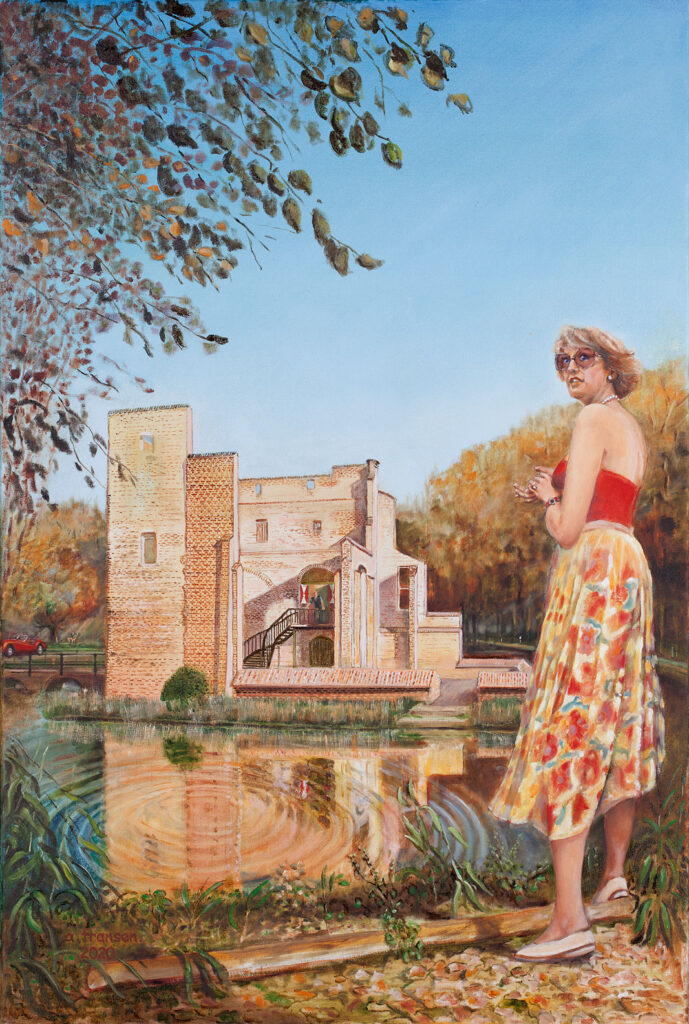
Liesbeth, my dream during the early 70s. For me, she was inextricably linked to Walhalla, our open youth society located in the castle ruins of Deurne.
Reminiscence
Bridge Over Troubled Water (Simon & Garfunkel).
https://youtu.be/5Mfs7ZZbKfw
Oracle
Five parts · oil on canvas (linen) · 170 × 200 cm · October 2019
Part of Manteion trilogy together with Hybris (2020) and Mouseion (2021)
An oracle from Delphi.

Somewhere within the cella of the now decayed temple, in or under the adyton, the Pythia used to give a glimpse into the future. She was sitting on a tripod above a crack in the floor and was a highly respected phenomenon for more than a thousand years! What nonsense, you would think.
Nine months a year, the oracle on the Parnassus was dedicated to the Greek god Apollo, the dignified god of medicine, the measure-keeping muse, and light. The other three (winter) months the Greek god Dionysos ruled over Delphi, the god of wine of course, but more generally of the exuberant vigour of the earth, of the delirious muse, and of theatre.
This painting is about moral duality, ambiguity and transience.
Reminiscence
Στο περιγιάλι (Sto Perigiali), ‘At the beach (the coast)’, performed by Maria Farandouri after a poem by Yorgos Seferis, with music composed by Mikis Theodorakis.
Read more
We are looking at what remains of the cultural centre of the ancient world.
Depicted on the left is a charioteer, after the famous bronze statue from 478 BC, now in the local museum. His stature is characterized by a proud attitude, yet his reins are broken. Has he lost control, does his proud attitude represent a theatrical rejection of the prevailing mores, or does he point to something else? On the right-hand side, while giving us a firm look and vehemently gesturing, the Pythia shows us a (sacrificial) dish containing wine and the call for axía. The Ancient Greek word axía, which still exists in Modern Greek, translates as ‘(monetary) value, worth, honor, dignity’ as well as the highly ambiguous ‘merit’, which can refer to wages, but also to punishment.
Plato speaks about the human soul as a winged horse carriage. The two horses want to go in different directions; Epithymia wants to go down, while Thymos wants to go up, and the charioteer has to keep both in line. Epithymia (or eros) stands for wealth and physical pleasure; in our society the dictated desire for consumption and for money, and therefore economic growth. Valuation, even self-esteem (also of the state), is derived from this; consequently, opportunism is lurking. Thymos stands for pride, fiery and intense, the appreciation for steadfastness or assertiveness, which stirs when alleged boundaries are crossed or when there is injustice. Viewed this way, opportunism and exclusively principled action are opposite measures of self-esteem. Plato’s charioteer stands for reason (or logos), so for balance between the two, that is, moderation. Judged by his posture, our own charioteer seems to either reject or transcend this duality: is there moderation in virtues such as empathy?
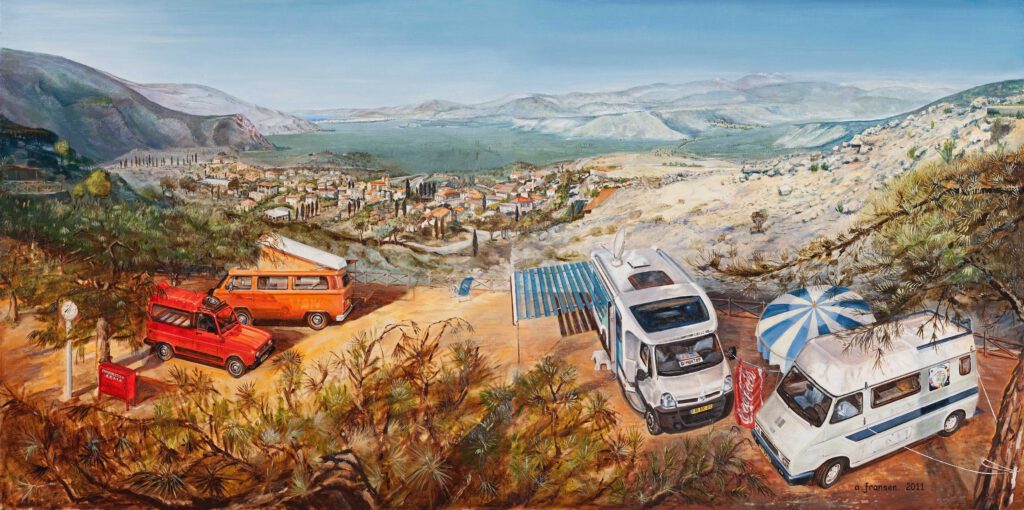
Delphi Camping
Oil on canvas (cotton) · 80 × 100 cm · December 2018
When light dispels the darkness.
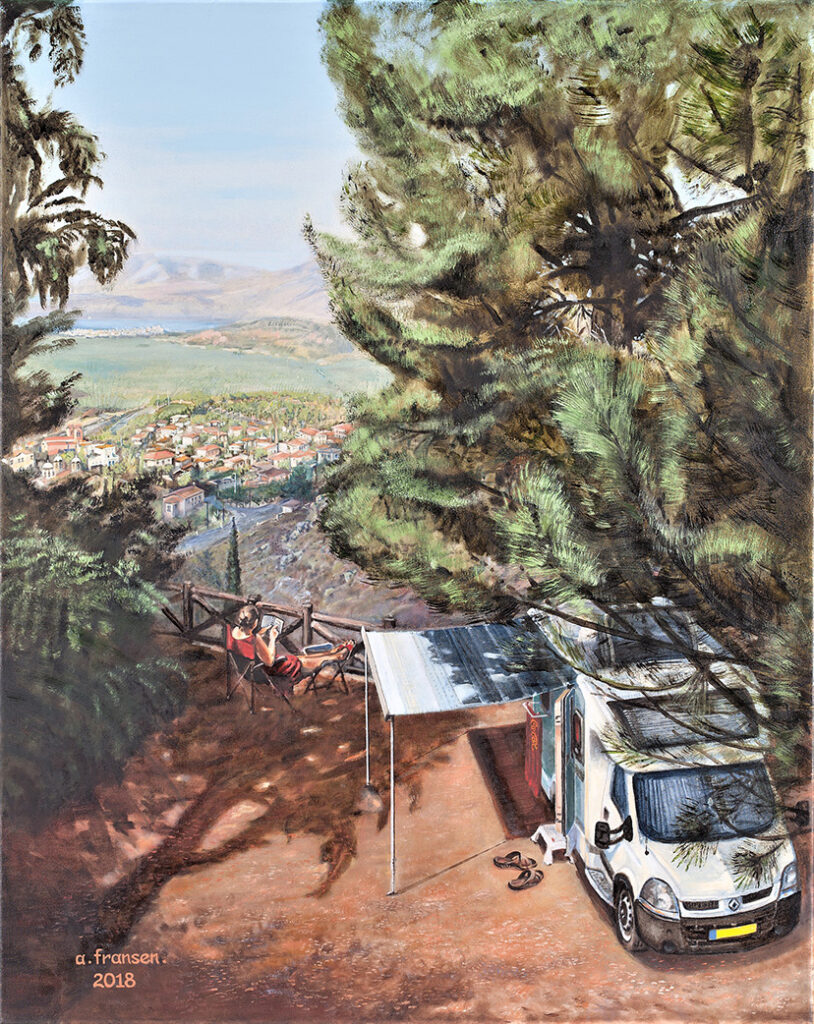
This painting refers to Amfi or Αμφι, an earlier painting from 2011. As in Amfi, it shows one of my most precious spots, and meanwhile also that of Liesbeth’s.
In fact, during the spring and summer of 2018, it was definitely our most precious spot because we no longer had a home and temporarily lived elsewhere or were on the road (D-HORTOP).
Reminiscence
Tis agapis aimata (Odysseas Elytis/Mikis Theodorakis (lyrics/music), performed below by Yannis Kotsiras.
Read more
Just like Liesbeth in this painting, I have spent hours and hours looking at this scenery since my first visit in 1974, especially at sunrise. I once read that the cult of the deity Phoebus Apollo, the illuminating and inspiring one, originated here. The following is a quote from the text accompanying Amfi, an earlier painting of mine.
When the sun is rising behind us and the first rays of light make their way through the Parnassos, then light dispels the darkness.
First, at the break of dawn, the mountains and the Pleistos valley in front of us lighten up. The light is rushing towards us, the shadows rapidly withdrawing. Down in the valley the crowns of thousands of olive trees colour silvery green. Below in Chrisso the white houses and the orange rooftops start to bloom in the sunlight. Goat bells echo on the bare slopes, and the crickets start their concert.
Garden Party
Oil on canvas (cotton) · 100 × 160 cm · December 2017
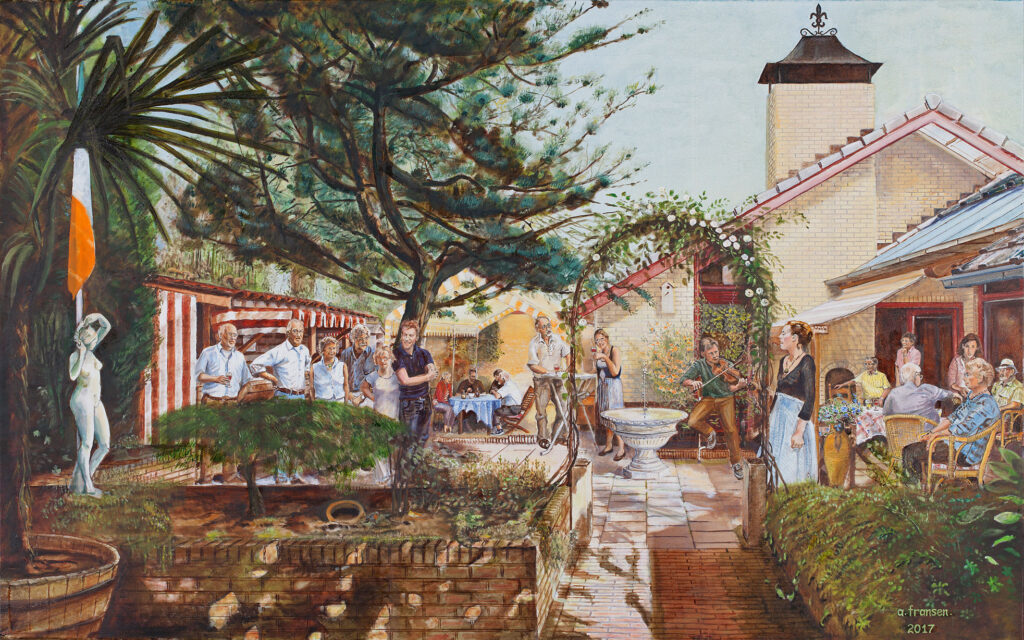
I have happy memories of the many garden parties over the years at the house where I have lived since 1971. Each year, in the middle of summer, we celebrated my birthday and that of Greetje’s, with friends and family. This painting is a souvenir, since Liesbeth and I are moving.
Reminiscences
The Parting Glass (here sung by Sinéad O’Connor)
Δύο πόρτες έχει η ζωή ‘Life has two doors’ (Στέλιος Καζαντζίδης)
Read more
An intimate environment is depicted here: the patio under the trees, with the sparkling fountain at its centre and my self-built cozy Taverna at the edge. The Greek and Irish music records being played added to the unique atmosphere.
In recent years, the party was occasionally graced by the singing of Marleen accompanied by Dorus, or by Dorus alone on his violin; mostly Irish songs, jigs and reels. The Irish ballad The Parting Glass — no less melancholic than Greek rebetika — would have fitted perfectly here.
Avignon
Oil on canvas (linen) · 60 × 120cm · June 2017
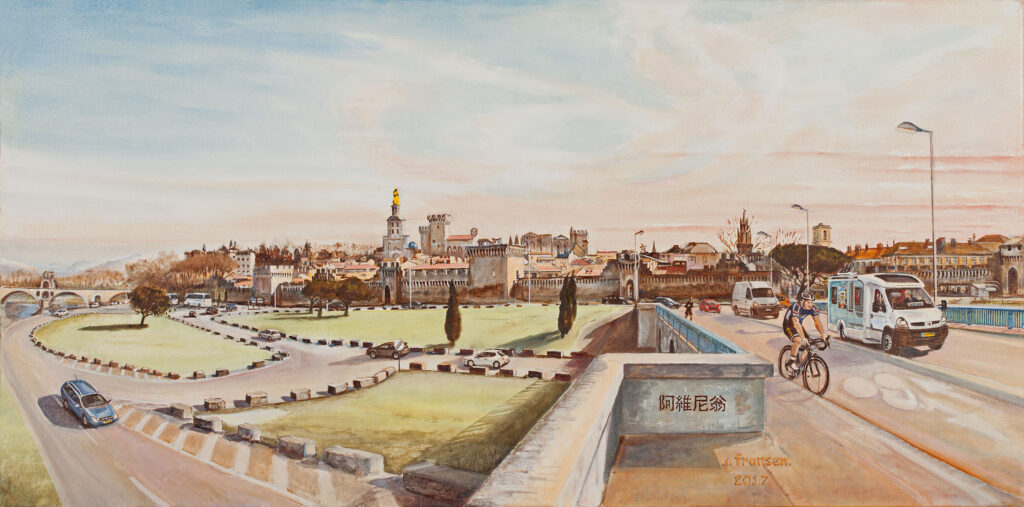
Libre circulation; merci ou malgré les remparts ‘Free movement; thanks to or despite the ramparts’
Formerly:
Until the Middle Ages, inner city walls, such as in Avignon, were considered safe from intruders and from unwanted influences. Free movement, albeit limited, existed by the grace of protective and isolating walls.
Today:
Thanks to the ‘breaching of walls’, there will be free movement of people, goods, services and capital everywhere, in the future; we are stronger together. But of course intruders and unwanted influences remain. Hopefully this freedom will become strong enough to serve the public interest, not that of a few.
Reminiscence
Soundtrack suite for Robin Hood, Prince of Thieves (composed and conducted by Michael Kamen).
Read more
The almost five kilometers long city walls of Avignon date from the fourteenth century, and are characterised by towers, arrow slits and gates. Before this wall, the city already had two earlier city walls; one from the Roman era and one from the thirteenth century.
The current walls were commissioned by Pope Innocent VI. The pope, as head of the Roman Catholic church, did not reside in Rome between 1309 and 1377, but in Avignon, because in Rome there was political confusion; Rome was simply too dangerous.
Aisling an Ógfhir (or Bus Átha Cliath) – environmental portrait of my son Dorus
Oil on canvas (cotton) · 100 × 150 cm · November 2016
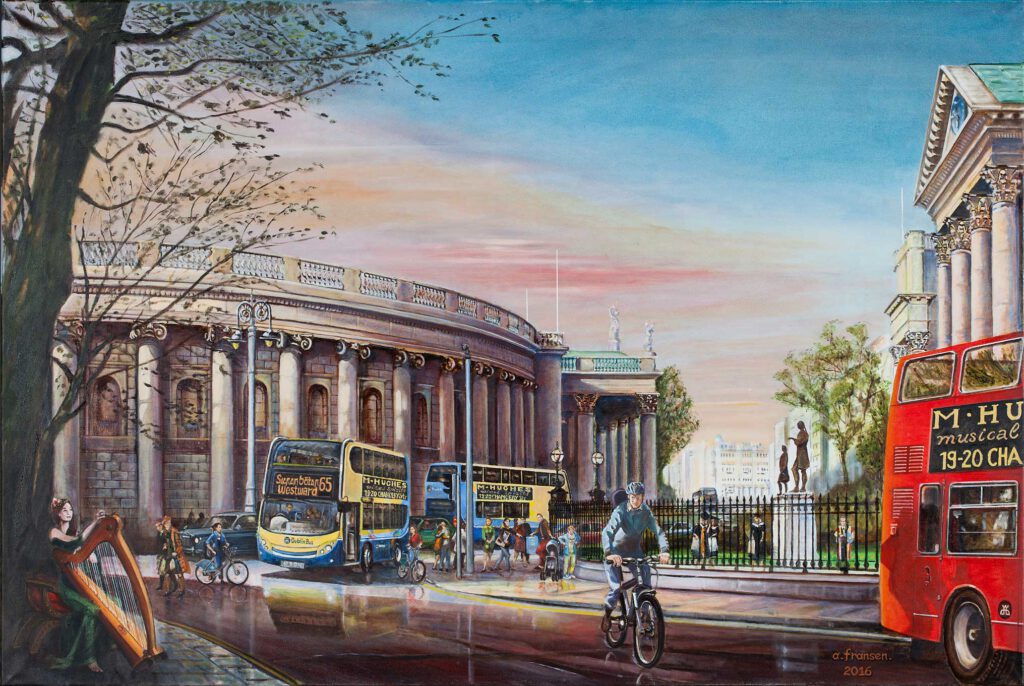
Aisling an Ógfhir is Irish for ‘The Young Man’s Dream’. This is also the name of an old Irish melody written down in 1796.
It seems to have been the basis for the Londonderry Air, better known as Danny Boy, and also for the popular song The Last Rose of Summer.
In folklore and literature, Ireland is often represented by a female being. She appears, lamenting her fate, in a dream (aisling) to a young man.
Reminiscences
Danny Boy (version by The Pogues)
The Last Rose of Summer (Celtic Woman)
Read more
Dorus emigrated in October 2010, immediately after receiving his master’s degree in Celtic Studies in Utrecht, only ‘armed’ with a backpack with some clothes and his laptop. And of course he took his violin with him.
Since then he has started to play music in pub sessions, has taken up various jobs and is progressing his studies further in what I call ‘Dublin, city of Dorus’.
Bus Átha Cliath is the name of Dublin’s public bus service. Baile Átha Cliath, or simply Áth Cliath, is the Irish for Dublin.
Ommelopan (‘to Ommel’)
Oil on canvas (linen) · 100 × 130 cm · December 2015
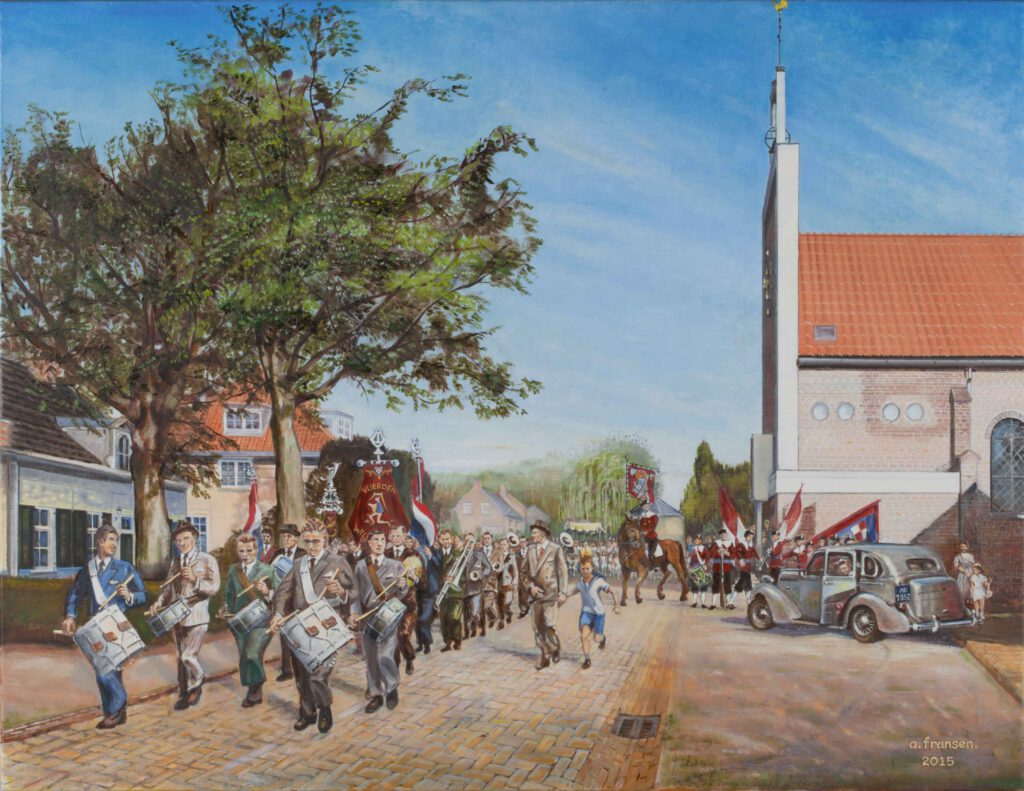
An early childhood memory and an euphoric moment; the pilgrimage from Vlierden to the nearby village of Ommel is about to start, with drums beating and flags flying. My father shouts ‘Saint Triphon’, the name of the march to be played, and my uncle Frans, a virtuoso drummer, starts his roll. Our legendary Studebaker from 1936 plays a shining supporting role.
Reminiscence
Saint Triphon by Arthur Ney (signature piece of my father’s brass band).
Read more
Ommelopan (Ommel-op-an) is a local way of saying ‘on the way to, going in the direction of, Ommel’.
It’s a sunny Sunday morning in May 1952, the month of the Marian devotions. The sun is still low and casts long shadows over the brick street pavement. Turning in the wind on the tower the cock spreads its golden sheen. The fanfare (brass band) leads the way in the annual pilgrimage to Ommel, a massive enterprise of the village community of Vlierden. The local Willibrordusgilde ‘Guild of Willibrord’ – originally a medieval militia company – shouldn’t be missing here, led by their prominent standard-bearer on horseback.
The heart of such a procession is the priest with the monstrance under the canopy, preceded by young girls dressed as brides, devoutly scattering colourful petals from their braided baskets. This colourful tradition faded over the years due to increased traffic along the route and changing views on social and spiritual values; the colourful petals would ultimately disappear in the floor drain.
Finally, an anecdote:
According to one of my father’s tall tales, the old Studebaker followed the procession steadily, unmanned; after all, the hefty six-cylinder engine didn’t just cut out. Mind you — we, mother and three children, were alone in the car in the passenger seats; dad purportedly only occasionally came down to adjust the car while standing on the running board.
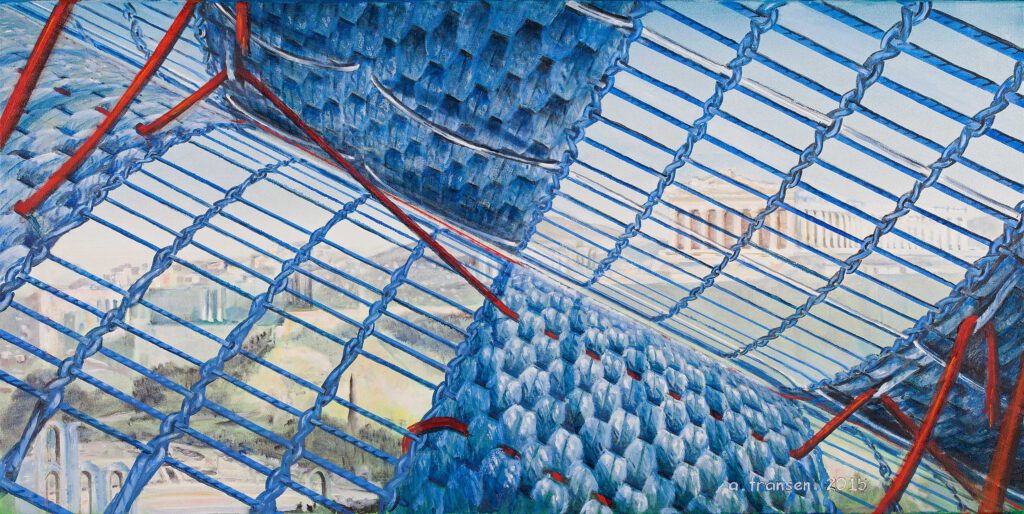
Fotofíltro 2 | Φωτοφίλτρο ß
Oil on canvas (cotton) · 50 × 100 cm · February 2015
Fabric & Philosophy
The artery of western civilisation: the fragile connection between inventiveness and sustainable profit is recklessly jeopardised by the pursuit of quick money.
Reminiscence
Acroyali (Yanni, together with the Royal Philharmonic Concert Orchestra, recorded live at the Odeion of Herodes Atticus, Athens, 25 September 1993).
Read more
I would call this an abstract self-portrait, although, technically speaking, it is not abstract and it is not a self-portrait either. It deals with a theme that often crosses my mind.
Just like Fotofíltro 1 (2009), this painting shows the design for a ventilating awning made of textile (this remains a passion of mine).
We see the construction of the fabric from the inside; complementary layers slide alongside each other but remain close together at the same time. As such, the fabric closes in whole or in part. We can see how this should have worked because the layers are pulled apart, rather abruptly, displayed with bloody red, partly broken connecting threads.
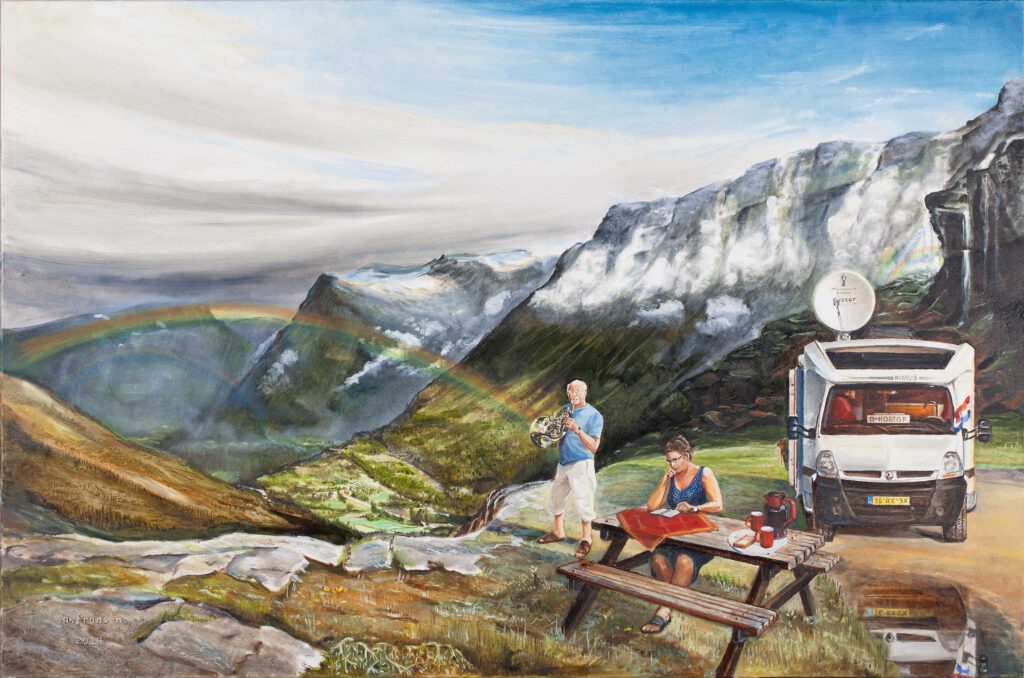
Morgenstemningpå Tverrfjellet
Oil on canvas (cotton) · 100 × 150 cm · November 2014
In the silence of these overwhelming Norwegian fjells and fjords, this summer, I was overcome with the sense of being surrounded by — and at the same part being part of — elemental forces.
Reminiscence
Peer Gynt Suite No 1 opus 46 Morgenstemning i ørkenen (Edvard Grieg 1875).
Read more
Morning Mood.
It is morning, mist clouds pull up from the fjords along the fjells around, lingering above the many streams and waterfalls. The sun light pierces through the cloud cover and the wind drives out the last nightly rainstorm over the ridges in the distance; a rainbow appears. The scene around the picnic table suggests a warm summer morning.
The sound of my horn fades away in echoes, and the silence returns. However, as soon as you notice the sounds of rippling water, falling down further away, you realise that the huge observed space is actually not empty at all. Just look at the satellite dish, and what about that great invisible force of nature: gravity.
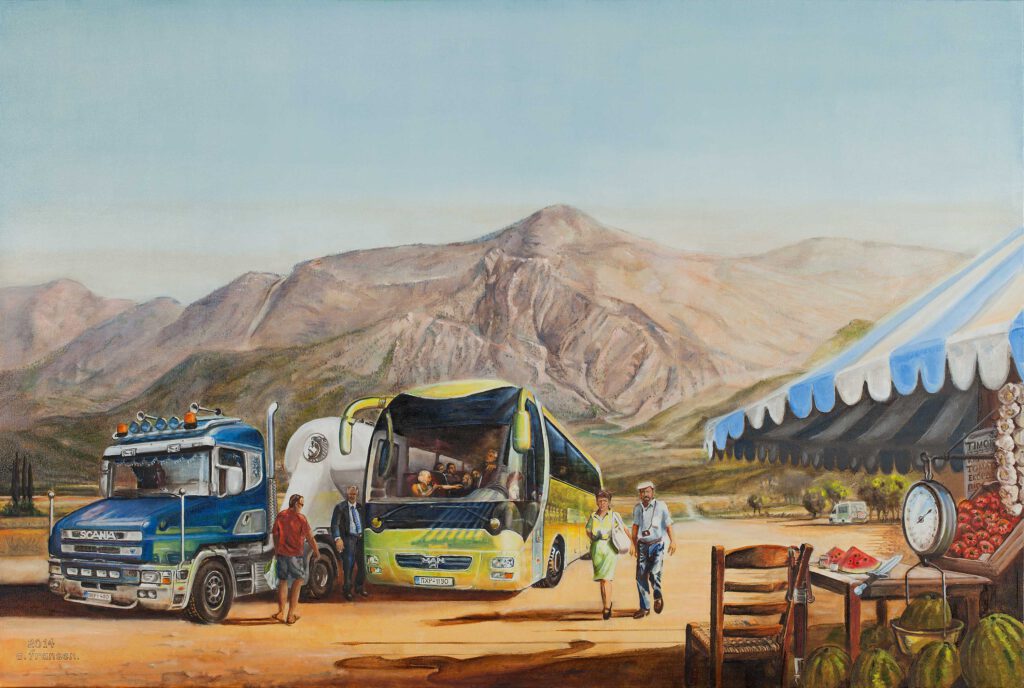
Kallídromos | Καλλίδρομο
Oil on canvas (cotton) · 100 × 150 cm · April 2014
Kallidromo is a mountain in southeastern Phthiotis and northeastern Phocis, in Central Greece. Its maximum elevation is 1,399 m.
This is about simultaneous experiences of one situation. What we ‘see’ depends on our own perspective.
Reminiscence
Brothers In Arms (Dire Straits).
Read more
What reality do we see as a spectator, and is it the same reality as perceived by my good friends, who have gotten off for a walk in this hot afternoon? And the passengers still inside the pleasantly air-conditioned coach, what exactly is pointed out to them?
This site contains the estuary of the Sperchios River, the homeland of Achilles. This is the imaginary spot where the hero collected his army of Myrmidons, ready to embark on their voyage to Troy, probably in 1190 BC.
The strategic narrow coastal pass of Thermopylae (‘The Hot Gates’) was also at the foot of this mountain on the left in the background. In August or September 480 BC, the Battle of Thermopylae took place here, between the Persian Empire of Xerxes I and an alliance of Greek city-states led by king Leonidas of Sparta. The ultimately remaining 300 Spartans, 700 Thespians, 400 Thebans and 900 helots had to face the infinitely larger Persian army. All Spartans died, including their king.
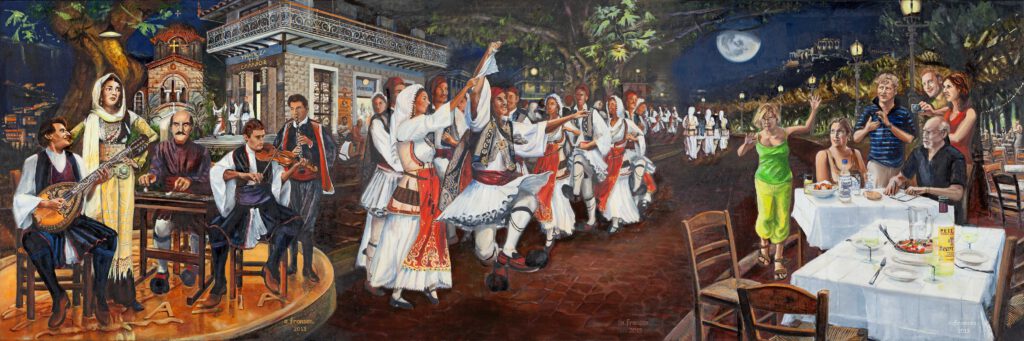
Tsakónikos Chorós | Τσακώνικος χορός (‘Tsakonikos dance’) – environmental portrait of my daughter Greetje
Oil on canvas (cotton) · 3 × 100 × 100 cm · December 2013
The Tsakónikos is a dance from the Peloponnese in Greece, more specifically from the region known as Tsakonia, for the most part situated in Arcadia.
This triptych is an expression of my love for my family and for the cradle of western civilization, for me personally to be celebrated by way of ‘listening, watching and tasting together’. However, the scene also refers to a different, and unfortunately common, view of Greece nowadays, a view exclusively determined by money. What does money represent anyway … ?
Reminiscence
Δύο πόρτες έχει η ζωή ‘Het leven heeft twee deuren’ (Στέλιος Καζαντζίδης).
Read more
I was introduced to this dance somewhere at a village festival in 1976. The combination of this dance with the typical costumes was something I saw later in the theatre of Dora Stratou on Philopappos Hill in Athens.
The musicians depicted in my painting are, within this staging, fitting icons in their own right – primarily celebrated Greek artists (including those from the Greek diaspora), yet intended as symbols of cultural transmission in general. Their traditional costumes therefore originate from widely scattered regions such as Boeotia (Tanagra), Epirus (Metsovo and Vovoussa), and even Crete. From left to right:
Concerning the Tsakónikos dance displayed here, Wikipedia mentions the following:
The dance is performed to a 5/4 (3+2) rhythm in an open circle which slowly winds in upon itself, forming a snail-shaped design. This labyrinthine formation is, according to legend, linked to the Crane dance of Theseus in Greek mythology, who slew the Minotaur in the Labyrinth of King Minos. It also has been linked to the slaying by Apollo of the Python at Delphi.
Music and dance, just like love, have the property to enrich all involved. For me, dance is a wonderful metaphor to show this exchange. A monetary exchange, however, does not always fulfill an enriching role for all involved; on the contrary, it often does only for one party at the expense of the other. Money all too easily also represents negative values such as power, violence, fraud and corruption.
To conclude, a citation:
Apollo, the god of light, defeated Hermes in running and Ares in boxing – mind conquered time, light conquered the dark forces of fraud and violence (Report to Greco, pilgrimage through Greece, door Nikos Kazantzakis)
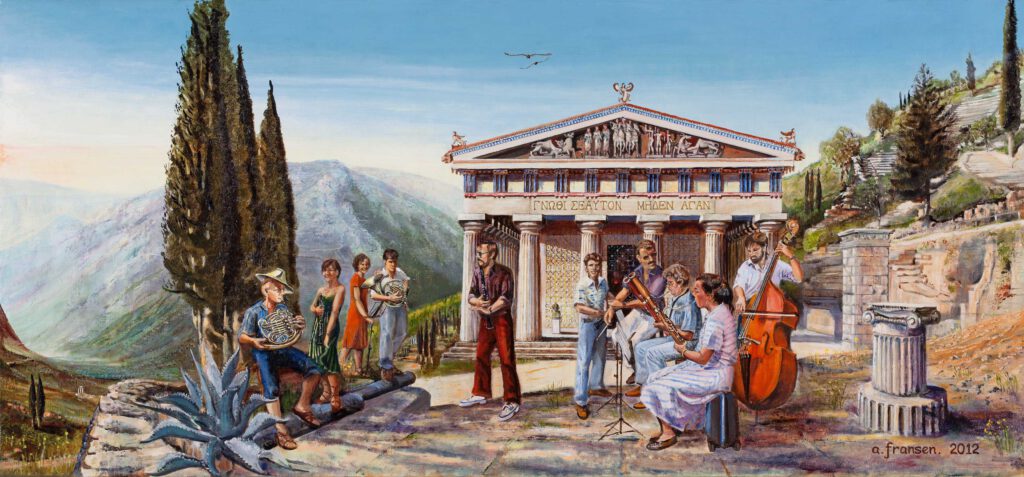
Témenos | Τέμενος (or I Bandisti in Delphi)
Oil on canvas (linen) · 65 × 140 (30 + 80 + 30) cm · July 2012
The name témenos refers to a sanctuary, in this case of the deity Apollo. Games were organised every eight years, which included not only athletics, but also recital and rhetoric, music performances and dance — going back to an ancient tradition connected to the primeval concept of light defeating darkness, later associated with the Greek muse. This was the centre of the world, for Zeus sent two eagles from both ends of the world, and they met over Delphi.
Reminiscences
KV 361 otherwise known as ‘Gran Partita’, part 7, Rondo (Mozart)
Ο καθρέφτης ‘The Mirror’ (Μάνος Хατξιδάκις / Manos Hadjidakis)
Read more
I Bandisti was the name of a wind ensemble. The name refers to members of a banda, in this case wind orchestra. Usually, however, the name was jokingly written as I Bandi(s)ti. This group also constituted a close-knit circle of friends in the 1980s. It is in this light, probably, that the thought arose to go to Greece with the whole gang. It never happened, but … everything is possible, in our imagination.
The scene is also imagined. The Apollo temple of Delphi, the fifth one on this spot, was built at the end of the sixth century BC. What must have been a marvelous building was destroyed by an earthquake in 373 BC, but was quickly rebuilt. It was not until 392 AD that Emperor Theodosius made an end to all pagan practices ‘worldwide’, which was the beginning of the end of Delphi’s temple complex and its associated oracle. The temple depicted here has been subject to looting and earthquakes, and it lies in ruins these days: only parts of six pillars remain.
Reference (Thales of Milete): The most difficult tasks of all are Know thyself and Nothing in excess.
Amfi | Αμφι
Oil on canvas (linen) · 2 × 100 × 100 cm · May 2011
The title Amfi/Aμφι translates as both ‘double’ and ‘around’. This seemed like a good starting point to me since it raises the question: How can double and around be part of the same concept?
Meditating on this interpretation of αμφι, and, more generally, on the apparent interrelationship of things, I hear myself thinking: Imagine that …
Reminiscences
Grateful and respectful memories of:
Conversations with Martien van Pinksteren
Watercolours by Avgéris Kanátas
From the concert program for Hungary, summer 2011:
Beethoven’s Pastorale (Symphony no. 6 part 1)
Dvořák’s Cello Concerto part 2
Read more
Counted up I have spent hours and hours looking at this scenery since my first visit in 1974; sometimes at sunset, but preferably and especially at sunrise. This dual representation suggests that seemingly different notions coincide: not only double and around, but also time and space, overview and insight, global and detailed, …
I once read that the cult of the deity Phoebus Apollo, the illuminating and inspiring one, originated here.
When the sun is rising behind us and the first rays of light make their way through the Parnassos, then light dispels the darkness.
First, at the break of dawn, the mountains and the Pleistos valley in front of us lighten up. The light is rushing towards us, the shadows rapidly withdrawing. Down in the valley the crowns of thousands of olive trees colour silvery green. Below in Chrisso the white houses and the orange rooftops start to bloom in the sunlight. Goat bells echo on the bare slopes, and the crickets start their concert. The light breaks through. Shape and colour get interconnected. It becomes clear how things fit together, how it exists.
The painting primarily expresses feelings of nostalgia for both the place and the past.
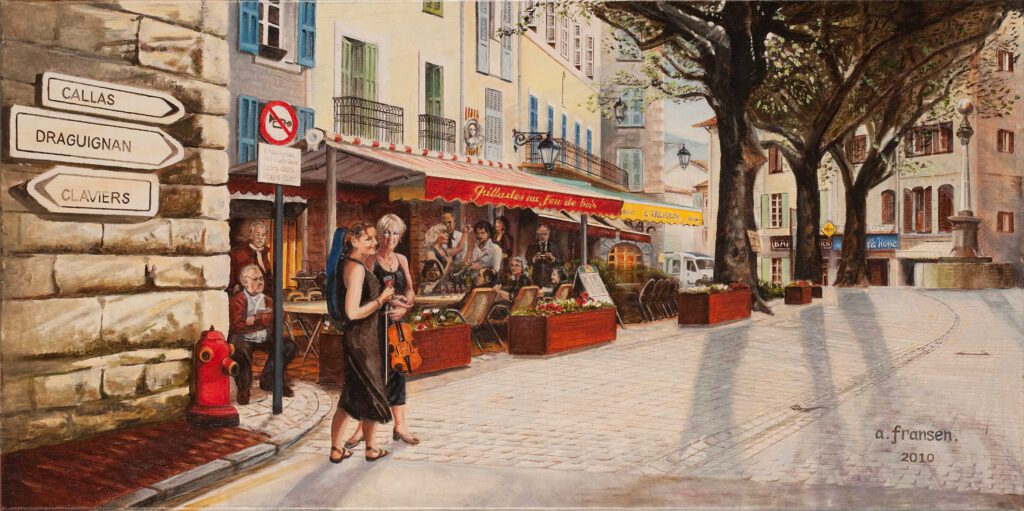
Bargemon (or Les Musiciens de Jacqueline)
Oil on canvas (cotton) · 60 × 120 cm · December 2010
For many years Jacqueline Wezenberg has arranged Orchestra projects somewhere abroad. Both in the spring of 2007 and 2010 Bargemon was chosen as our destination, a village in the Haute Provence located near the city of Draguignan in Southern France.
In this painting I’m trying to capture the warm interpersonal atmosphere that developed over the course of these projects.
Reminiscences
2007
Otto Bentinck’s oboe solo in Bizet’s symphony 1
The Last Post on the evening of May 4 (played by Jos Vossen)
2010
My horn part in Felix Mendelssohn’s Symphony 4, also known as the Italian
Read more
My retirement in 2007 made it possible to take part in such projects. Both in 2007 and in 2010 the weather was extremely bad; it rained nearly every day and night during the week of our stay.
Most members of the Orchestra were staying in Chateau de Reclos, also our rehearsal space, every morning, from Monday to Thursday, from 9 am till 1.30 pm.
Thanks to everyone’s involvement in the beautiful music, the inspiring and very precise conductor Kian Pin Hiu, and Jacqueline and her husband Eef’s good care in particular, the atmosphere in the Orchestra was excellent during both occasions.
Transforming a chilly and rainy Bargemon into a sunny village scene is rather superficial; the warm atmosphere created, however, is not.
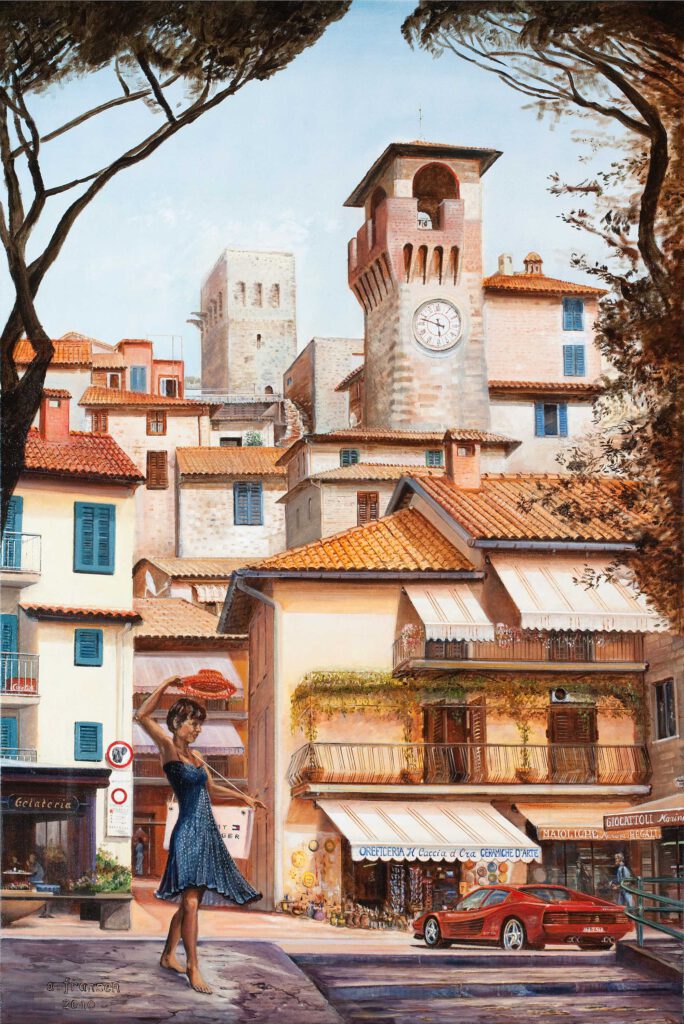
Passignano
Oil on canvas (linen) · 80 × 120 cm · April 2010
In the summer of 1999 I made, as I often did, a drawing in my diary. After more than 10 years I made this painting from that sketch.
‘That we may remember this place with good feelings.’
Reminiscences
Since the foundation of the city, Livy, Book XXII, 2-7
The Battle of Lake Trasimene (217 BC)
La Danza from the ballet La Boutique Fantasque (Ottorino Respighi)
Read more
After an intensive camper trip to and across Greece, it was quite a relief for our children Dorus, Teun and Greetje to spend a relaxing week on a nice campsite, such as the one at the lake of Trasimeno (Italy).
Liesbeth and I also enjoyed this rest, in the company of our friends Jan and Marij Brans and with their children Marjolein and Pieter.
To me, relaxation and enjoyment included much reading and writing, and also bike rides on my ATB in the early morning or late afternoon. Armed with my drawing supplies, acrylic paint and a bottle of water ‘for general use’, I was also on the hunt for a ‘spot’.
I found such a place in Passignano itself, and made a drawing in my journal.
Fotofíltro | Φωτοφίλτρο
Oil on canvas (linen) · 60 × 120 cm · November 2009
The motivation for creating this work stemmed from a somewhat rash promise at the farewell reception of my former colleague Wolfgang Knöbel in 2007. For me at least, his departure had been an unexpected one, and I hadn’t prepared a gift. So I said: ‘I’ll make a painting for you’. Along the way it became a symbolic scene which I knew Wolfgang would understand and appreciate.
Reminiscence
Robbin’ Pirates (The Redlocks, former band of my boys Dorus and Teun):
Read more
The scene focuses around the developmental stages of an outdoor textile sunblind, a project I embarked on towards the end of my professional career, and in which Wolfgang took part (I remain passionate about the matter). The printed lotus flower on the product represents the dirt-resistant behaviour of the fabric in outdoor contexts. This behaviour, and the nanotechnology involved, was Wolfgang’s contribution to the product’s development.
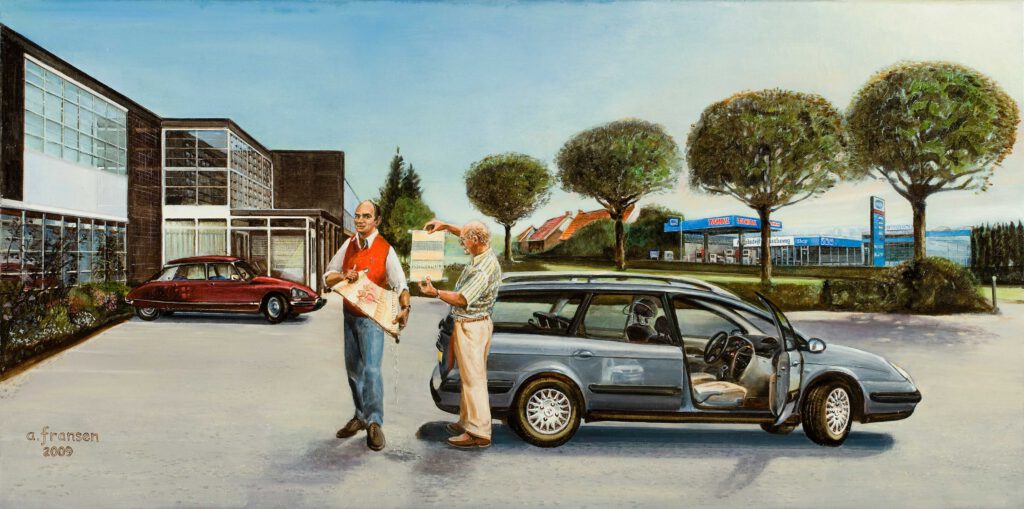
A secondary theme incorporated in the painting derives from the conversations I used to have with Wolfgang, in which we discussed matters relating to innovation (the latter has degenerated into a buzzword these days, in my opinion). Usually during these chats, it didn’t take long before we found ourselves discussing the Citroën DS, as an example par excellence of innovation avant la lettre.
The Greek title Fotofíltro, the working title for the outdoor sunblind product, means ‘light filtering’, analogous to the Latin Luxaflex (for light deflection), the famous brand name. The Greek letter Φ (phi), present in the title twice, also symbolises a commonly used mathematical ratio in painting: the divine proportion. I thought it would be interesting to concentrate both the subject matter and the vanishing point in the divine proportion.
Reference:
The divine proportion: Φ = (1+√5) / 2 = 1.618…
Anachrón | Αναχρόν
Oil on canvas (linen) · 60 × 80 cm · February 2009
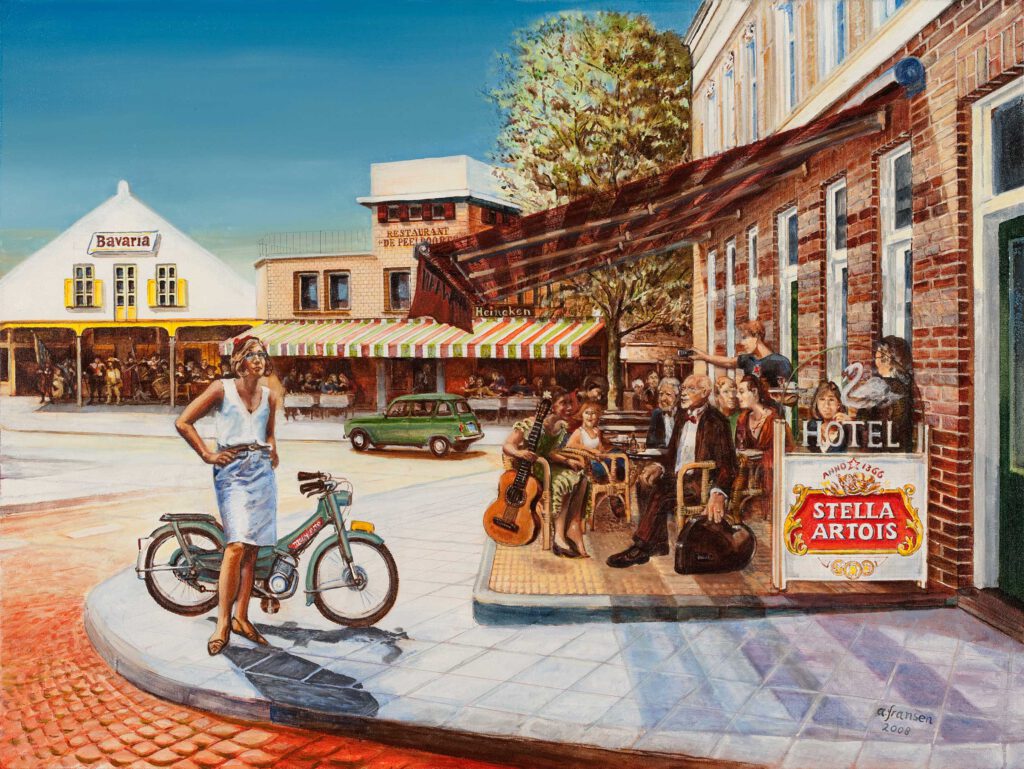
The painting depicts the Markt (‘marketplace’) in the town of Deurne, in a quasi-realistic manner, while the Mediterranean character is illusory.
Everything revolves around Liesbeth in our early years (1970), the girl of my dreams; unreachable, back then, or ever … ?
Instead of being a mere collection of individuals, a group of people should be a coherent set, so I looked for examples! Past and present occur simultaneously, making us reconcile what is chronologically irreconcilable.
Reminiscences
Fond memories of Toon and the round table in De Peelpoort, our local pub in those days
Στρώσε το στρώμα σου για δυό ‘Make up your bed for two’ (Μίκης Θεοδωράκης):
Metéora | Μετέωρα
Oil on canvas (linen) · 90 × 70 cm · May 1984
Floating between heaven and earth
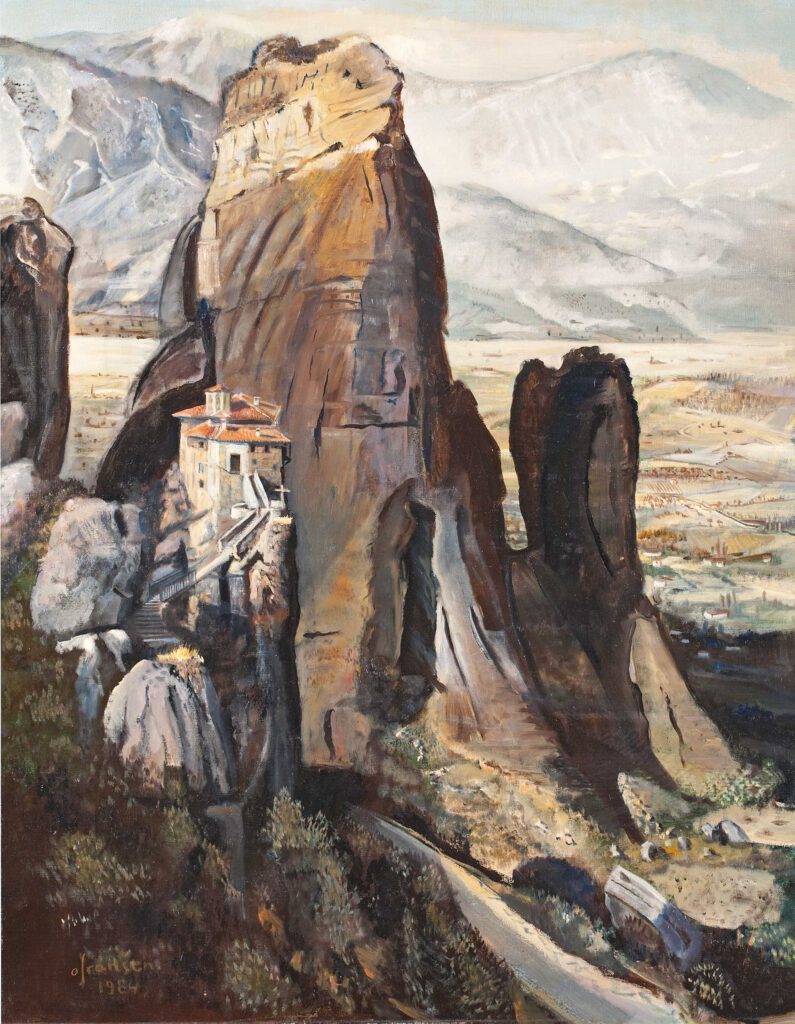
Moni Rousánou is just one of the many imposing monasteries in this wondrous place.
The idea of living, working and — especially — staying in such a place intrigues me.
Reminiscence
Sergei Rachmaninov’s Vespers (no 2 Praise the Lord, My Soul).
Read more
An impressive environment of age-old monasteries on rocks thousands of years old, the latter constituting the foothills of the Pindos mountains above the Valley of the Pinios River, which flows into the Thessalian Plains.
The scenery is a witness of the past, both in terms of the geological and cultural processes of change. It upsets my sense of time and space … over and over again.
It would take almost 25 years before I started my next oil painting, in 2008. Shortly after completing this painting, my father, who had always inspired and stimulated me, died, and my eldest son Dorus was born. Moreover, I felt that the intense process of painting was incompatible with my professional life and my new responsibilities.
Orchéstra | Ορχήστρα
Oil on canvas (linen) · 120 × 150 · May 1982
Orchéstra, originally ‘dance floor’; the place to get in line. Who is participating, in a figurative sense? Who rightfully jumps into line, or conversely out of it, when it comes down to it, and who is proven right in the end? Put differently, who gets the credit? Heroism can be seen as a tension between the driving forces of arrogance vs. empathy — a theme evoking intense emotions, gratefully used in the arts, not in the least in music.
Reminiscences
Warm thoughts of fellow musicians, past and present
Bergson’s philosophy
Eroïca (Beethoven)
Read more
In a sense, music is an architectural design set in time. Being a mathematical construct, it is neatly divided into note lengths, bars, phrases, themes and parts of, for example, a symphony. This in itself can be experienced as something beautiful.
However, a short single tone sometimes encompasses a world of musical emotion. On the other hand, one may recall a long symphony as if it were a single breath. As such, this precious experience is completely independent of measurable time.
Such an experience among the musicians — the orchestra — is shown here, the colour and lighting functioning as a metaphor for a fireplace. Its radiating warmth and light will hopefully also reach the audience.
Many of my friends revolve around the orchestra — both in space and time.
Fanfare (‘Brass Band’)
Oil on canvas (linen) · 60 × 80 cm · September 1980
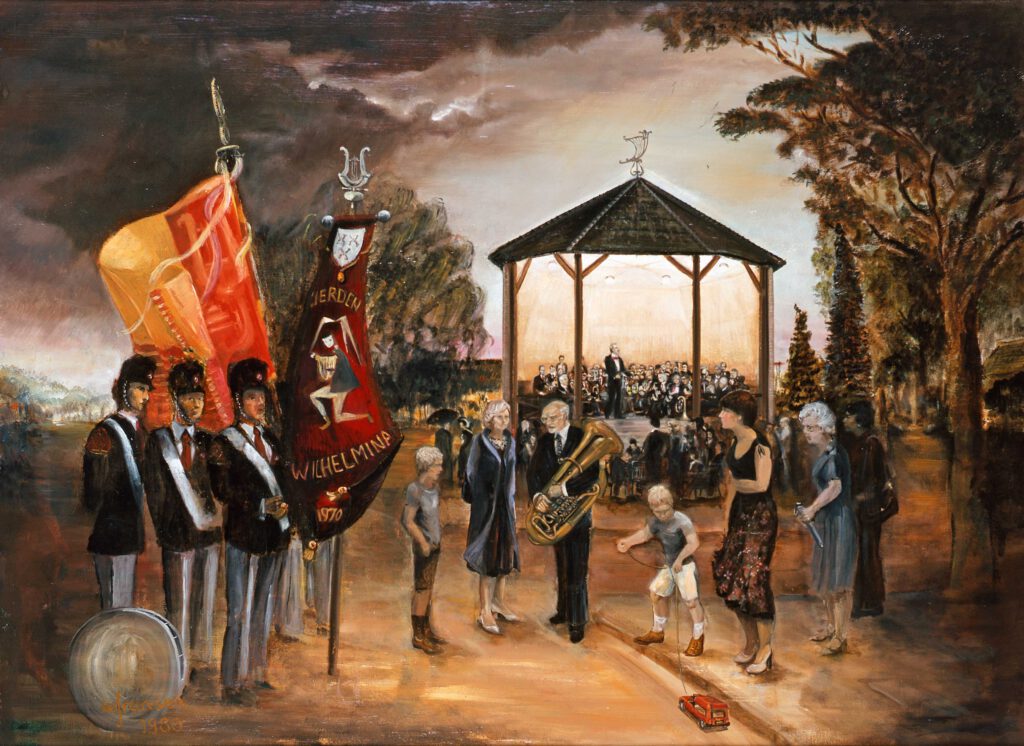
This painting was a gift for my father on his 75th birthday.
It’s about the brass band, his band, of which he had been a zealous conductor for more than thirty-five years. When he left, the band — in his opinion — was still lacking a bass tuba. So I decided to ‘make’ one for him.
Reminiscences
Warm memories of my parents
Finlandia (Jean Sibelius) – my father’s favourite musical piece:
Read more
My father was a great leader with a rich imagination and the ability to inspire many musically as well in other areas.
The latter included technology, a discipline he was adept at both in terms of design and practical implementation; he was exceptionally clever with his hands. In the scene depicted he’s trying to fix someone’s instrument at the last moment, as happened occasionally. After all, even with such a beautiful tuba, a cylinder does get stuck sometimes.
Drómos | Δρόμος (‘road’) – A landscape fantasy
Oil on canvas (linen) · 90 × 120 cm · December 1979
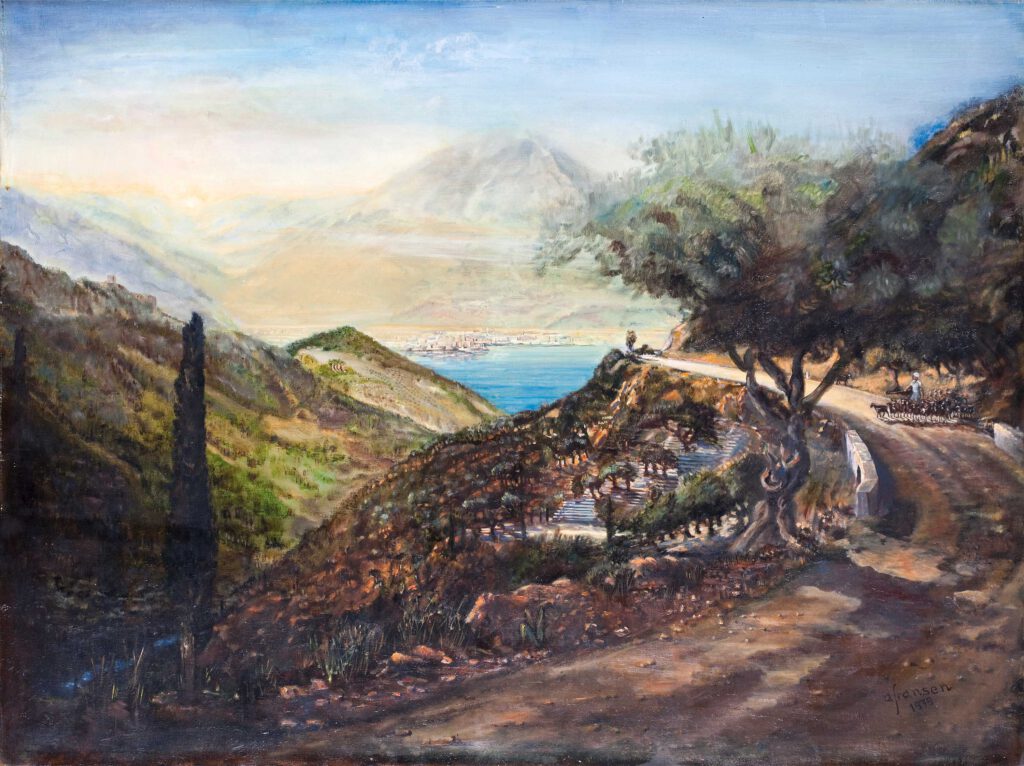
Is it because of the Greeks, their century-long history and its significance, or their friendly hospitality, or their music and their food? All true but … it certainly also includes the landscapes that, unmatched in beauty, are an important attraction for me!
Reminiscence
Ο Μύθος ‘The Story’ (I’ll tell you a story) (Manos Hadjidakis / Nana Mouskouri).
Read more
The place depicted does not exist but is a compilation of landscape elements.
Suddenly a herd appears on the road, accompanied by this lonely man, hours away from the inhabited world, alone with his dog and the goats, their smell mixed with the scent of herbs on the slopes. Sometimes I like to imagine I’m him, obviously as an escape from daily life’s pressure …
The sun, still rising, drives the morning mist away, and will soon start to scorch the slopes and the plains. The road winds along a mountain flank, following the course of a small river deep down below.
An antique theatre — its location seemingly arbitrary — is overgrown by an olive grove, partly excavated. A medieval castle (Kastro) from the time of the Crusaders is scarcely visible, as if insignificant; yet it’s always strategically located on a hilltop overlooking a bay, an inlet of the sea, which is never far away in Greece.
The town on the horizon, hardly visible from our viewpoint, will have it all tonight: Cafés and tavernas and their canopy-covered terraces. The smell of souvlakia, snatches of music from the ‘ringing-sparkling bouzouki’. Elegant women and girls strolling in the evening coolness, impossible not to be seen … HELLAS.
Klóstria | Kλώστρια (‘wool-spinning woman’) – A fantasy scene
Oil on canvas (linen) · 90 × 70 cm · May 1978
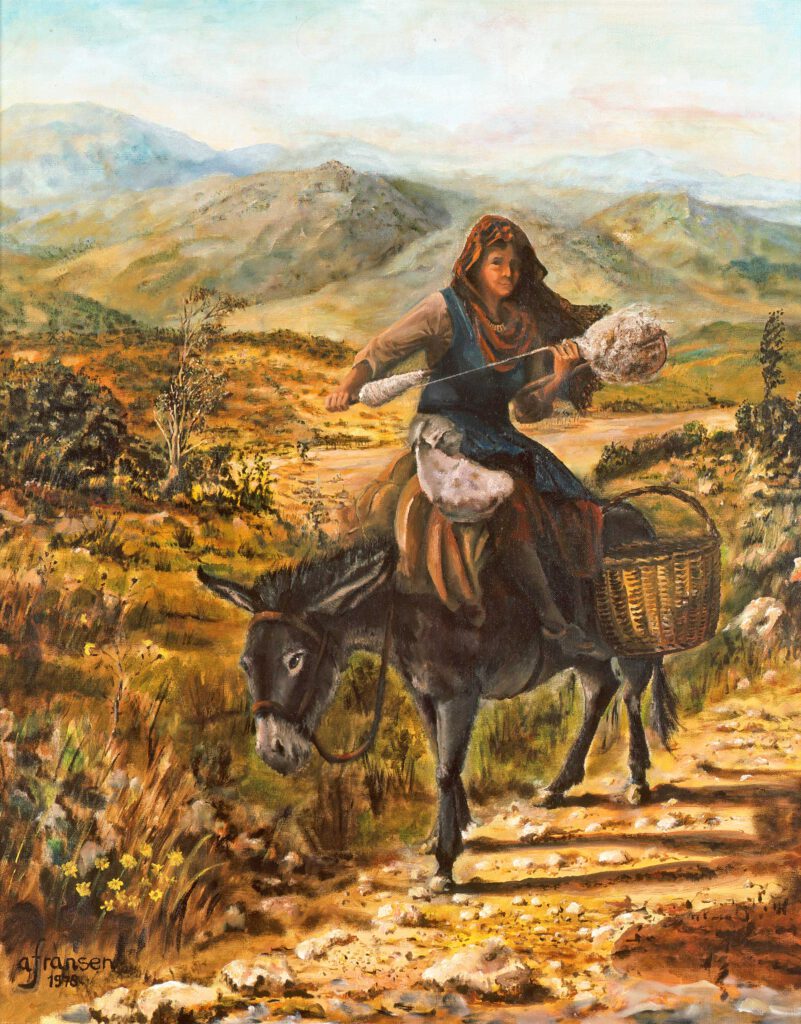
In my capacity as textile technician I was once struck by the spinning process depicted here. My first thought was: ‘This must be very difficult, and it doesn’t make you rich!’ But on reflection: ‘It doesn’t make you poorer either, and it fits in a context’.
Reminiscence
Se potisa rodostamo ‘I poured you rose water (but you poured me poison)’ (Nikos Gatsos / Mikis Theodorakis / Maria Farantouri).
Read more
You meet them in the most remote areas across Greece; flocks of sheep or goats, or both. Sheep in particular lose tufts of their wool to the spiky vegetation on the dry mountain slopes. The shepherd girl, behind the herd, collects these flakes and sticks them on a distaff. She clamps this forked wooden stick, often decorated with carving, under her arm. The process of loosening the wool fibres, laying them out in parallel and rotating them around each other all simultaneously using a rotating spindle is what we call spinning. Winding it on the same spindle — the subsequent and last phase of the spinning process — is depicted in this painting.
Imagine this process being carried out on the back of a donkey, heaving and choppy, and you’ll appreciate the significance of practice …
Both the subject and the environment — although derived from actual encounters — are fictional.
Athens | Αθήνα 1974
Oil on canvas (linen) · 70 × 60 cm · December 1977
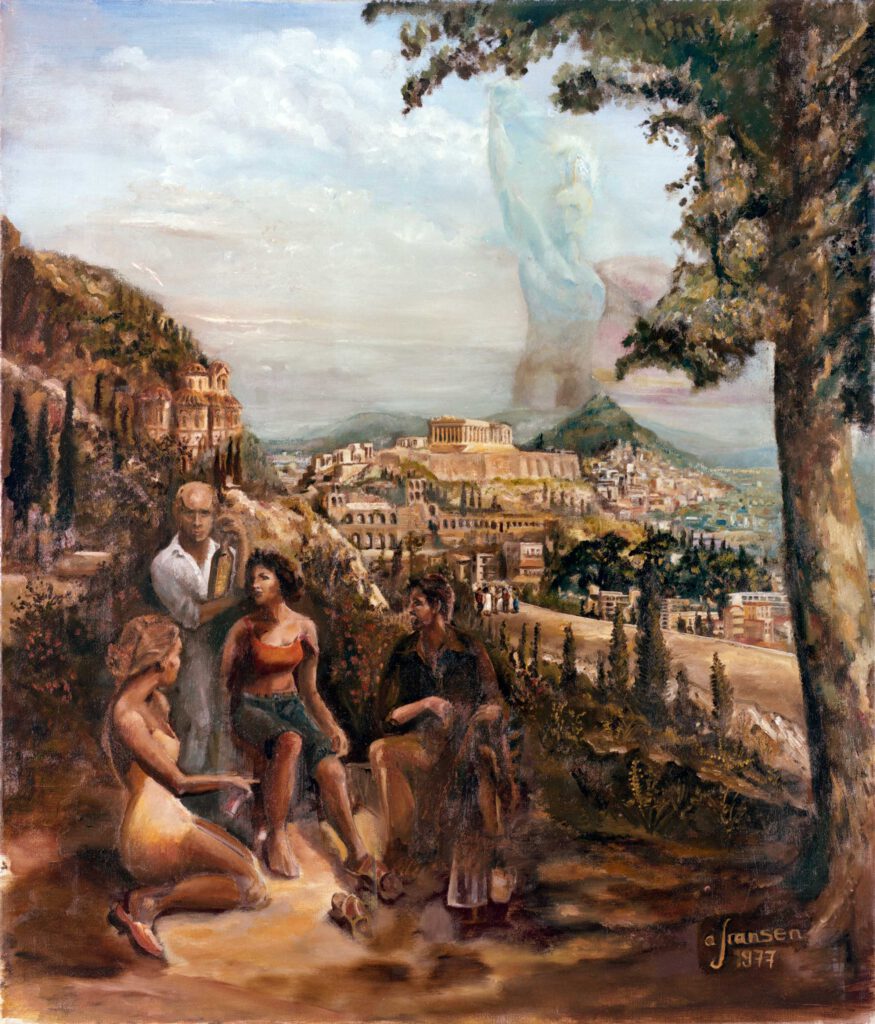
DEMOCRACY RESTORED IN … ATHENS.
The statue of Leonidas at Thermopylae — admittedly having little to do with Athens — rises up above the city, personifying democracy.
Reminiscence
Χρυσοπράσινο φύλλο ‘Gold green leaf’ (= Cyprus) (Μίκης Θεοδωράκης).
Read more
Ancient times have fascinated me since secondary school, especially the Greeks and the Romans. After Rome in 1973, Athens became the destination of my summer holiday trip in 1974. I went together with my friend Jan Brans, my travel companion from the year before. During our stay in Delphi we met two like-minded girls, named Tine and Anne, who had perched on the same Delphi Camping. I have never seen them after that eventful journey, by the way.
Just as we were settling in and going around Delphi, with its magnificent excavation site, the political troubles of the early 70s in Greece started. Somewhat later it became clear that the Greek colonels had supported the coup against Archbishop Makarios on Cyprus in order to force annexation (enosis, ‘connection’) of the island. The Turkish government responded with the threat of war, which caused an overall mobilization in Greece.
As a result, we found ourselves in a situation without any money, food or gasoline… and yet it was an interesting and exciting experience. The political solution came on the day that the exiled former prime minister Konstantinos Karamanlis returned from Paris. His return sparked great excitement and a huge folk festival unfolded around the Acropolis (Plaka) and . we were there (of course!), eye-witnessing it all.
Even after a few days, back on the road again, there was much talk about the events within our travelling group, until it was time … time to go our separate ways.
Walhalla
Oil on canvas (linen) · 60 × 40 cm · May 1970
Everything was intense, we could shape the world as we wanted it to be. Wonderful themed festivities in summer and winter, encounters of all kinds, listening to music, socio-political discussions, friendships, love, but also disappointment; it was all there, at that place, during that time.
Reminiscences
The Boxer (Simon & Garfunkel)
When I’m Sixty Four (The Beatles)
Read more
The foundation in 1965 and the first years of De Open Jongerensociëteit (‘The Open Youth Society’) Walhalla were exciting as well as instructive. The thought of making the castle ruins of Deurne our home was covered in romance and it brought about a huge amount of enthusiasm. It was followed by a period of hard work and arduous negotiations with the local authorities; you can imagine what the opening ceremony of Walhalla was like, after we had succeeded.
When I made this painting, it had already been more than five years since the original idea of our own youth society had come up. Inevitably, a schism had taken place between those of the foundation and those of the renewal. However, years after its foundation, our motto was still a weekend at home, a night out at Walhalla, even though we were studying elsewhere, had gone in military service, or were already working at that stage.